Send the exact assignment or rubric from your classroom and a custom sample written to it lands in 24 to 48 hours, the first one free. DDBA 8560 is Walden’s Seminar in Healthcare Managerial Decision Making course. It centers on deciding inside limits a manager does not set, and writing the decision so the limit it respected stays visible. Some program versions carry this course as DBAX 8560; the same drawers apply. Searches like "ddba 8560 week 4 assignment example", "DDBA8560 sample paper", and "DDBA 8560 week samples" land on this page.
What DDBA 8560 is really about
Managerial decision making in a health setting is not general decision making with hospital nouns dropped in, and this seminar is built on the difference. A large share of the decision space already belongs to someone else: to clinical judgment, to licensure, to standards of practice, to what a service is physically able to do. The administrator works with what is left over, and doctoral writing here is graded on whether you show that you know which part is yours. A paper that recommends a change to something its writer has no standing to change reads as unserious however well it is argued. Sections differ in the cases they hand you, but that demand holds steady across classrooms.
The second demand is evidence that behaves like evidence. A doctoral paper about a decision names the method that produced it, and every method has an author: expected value, weighted criteria, cost effectiveness, whichever the week calls for, traced back to the source that set it out rather than to a textbook summary of it. Where you draw on your own facility, that material stays yours; write about a service line and a set of operating conditions rather than naming an employer, and the argument loses nothing at all. Graders read for the distance between an assertion and its support, and at this level that distance is where most of the available points sit.
What DDBA 8560’s assessments ask for
Expect two sizes of writing inside a single week. The discussion wants a stated position on a decision problem, argued, with replies that press on a peer's reasoning instead of endorsing it; an initial post that only summarizes the reading reads as filler at this level. Assignments run longer and tend to follow one shape: state the problem, state what cannot be changed about it, lay out options in a single set of terms, apply a named method, recommend. Middle weeks apply that shape to a supplied case or to a setting you choose. Later weeks stack those pieces into one longer paper that has to hold together end to end. Formatting and current sources carry real points in current classrooms, scored apart from the argument itself.
Where students lose points in DDBA 8560
The largest single loss is the recommendation the writer has no standing to make: a paper that reorganizes clinical practice when the assignment asked how to run a service around it. Close behind is the method described and never used, three paragraphs explaining weighted criteria followed by a choice made on instinct. Points also go when the alternatives are not real, one option written to win and two written to lose, because a grader can see the rigging from the first table. Then the ordinary drains, the generalization about health systems with no source attached, the estimate whose origin is never given, references built from memory, and a peer reply that agrees warmly and adds nothing. None of these need more knowledge to fix.
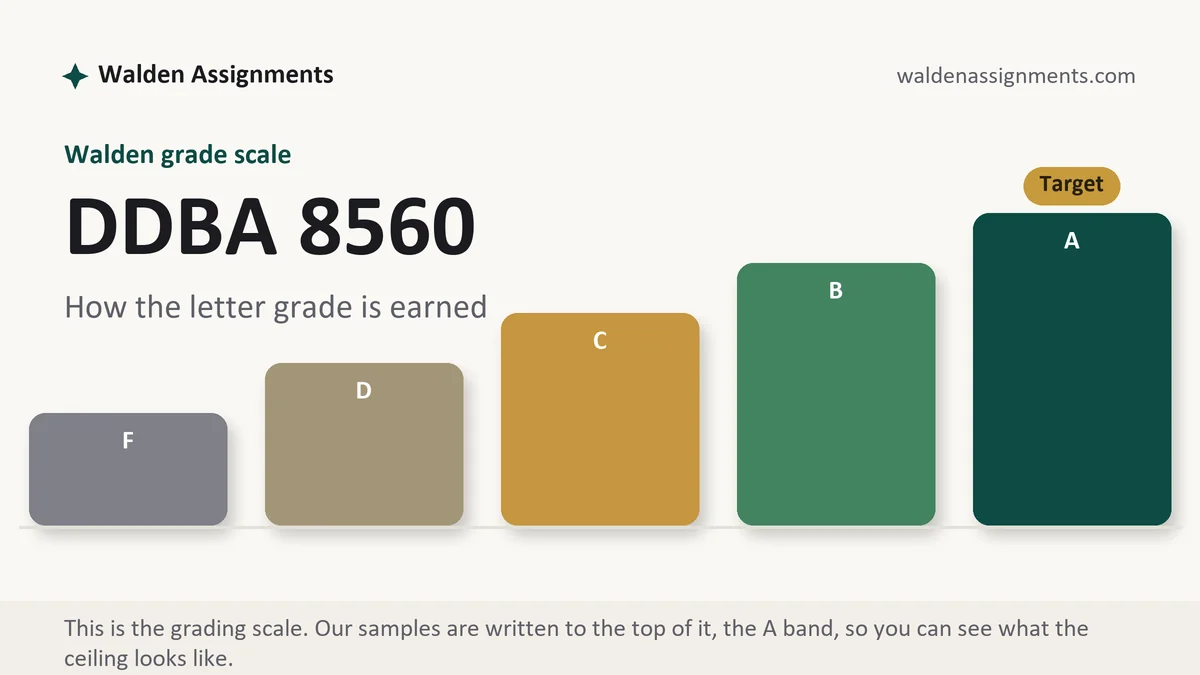
The DDBA 8560 drawers
DDBA 8560 Week 1 discussion post example
Week 1 often opens with a post separating what a manager decides from what a clinician decides. On request, free, 24-48h.
DDBA 8560 Week 2 problem statement example
Week 2 typically wants the decision problem written down in one page, boundaries included. On request, free, 24-48h.
DDBA 8560 Week 3 evidence memo example
Week 3 usually turns to where the evidence comes from and how current it must be. On request, free, 24-48h.
DDBA 8560 Week 4 criteria matrix example
Week 4 commonly brings the first graded paper, with criteria named and weighted before any option appears. On request, free, 24-48h.
DDBA 8560 Week 5 options analysis example
Week 5 generally asks for several options described in one vocabulary, so the comparison stays honest. On request, free, 24-48h.
DDBA 8560 Week 6 risk brief example
Week 6 frequently adds uncertainty, asking what the estimate would look like if it were wrong. On request, free, 24-48h.
DDBA 8560 Week 7 cost case example
Week 7, as a rule, prices the preferred option in resources a budget owner would recognize. On request, free, 24-48h.
DDBA 8560 Week 8 stakeholder brief example
Week 8, in most sections, maps who has to agree before a decision can actually move. On request, free, 24-48h.
DDBA 8560 Week 9 implementation plan example
Week 9, in many sections, converts the choice into a sequence with owners and dates attached. On request, free, 24-48h.
DDBA 8560 Week 10 monitoring plan example
Week 10, more often than not, names the signal that would show the decision going wrong. On request, free, 24-48h.
DDBA 8560 Week 11 decision paper example
Week 11, as a rule, closes on one recommendation the clinical limits can actually bear. On request, free, 24-48h.
Your classroom shows something else?
Walden University revises courses; week counts and deliverables shift between terms. Send what your classroom shows and the desk matches it exactly.
Using a DDBA 8560 sample the right way
The decision behind every finished example on this shelf is narrow: choose one option and be able to say why the others were set aside. Watch how the paper earns the right to say it. The limit it could not move is stated before the choice is announced, the rejected options are described in the same terms as the winner so the comparison is fair, and the criteria are attributed to someone other than the writer. That sequence is what makes a closing recommendation land instead of assert. Take the sequence and the fairness of the comparison; leave the case behind, because your week hands you its own.
How these samples are written
The discipline behind every paper here: the rubric is the outline, each row gets its section, discussions get the thread treatment with substantive replies, and the format layer ships exact. Send your classroom's rubric with a request and the sample matches it, revisions included.
DDBA 8560 questions, answered
Does DDBA 8560 ask me to make clinical judgments?
No. This is a management seminar, and the papers stay on the management side of the line. A sample here reasons about staffing, capacity, cost and sequencing, and it treats clinical judgment as a given it works around rather than something it revises. Nothing on this shelf claims an effect on patient outcomes, and no sample tells a clinician what care to provide.
My classroom's case is different from the one in the sample. Is it still useful?
Yes, because the case is the part you replace. What carries across is the order of the argument: problem framed, boundary named, options in one set of terms, method applied, recommendation with its own test attached. Swap the setting and the numbers and the structure still holds. If you want the sample built on your own case, send the prompt and the rubric and the first one is free.
Can I build the paper on my own hospital's data?
You can write about the operating conditions you know, and that experience usually makes a stronger paper. Leave the employer unnamed, and do not move internal figures into a document that travels; describe the kind of number and where a reader could find a published equivalent. Nobody drafts a paper from your organization's internal records, and a sample here never asks you to supply them.