Send the exact assignment or rubric from your classroom and a custom sample written to it lands in 24 to 48 hours, the first one free. MMHA 6300 is Walden’s Law and Ethics in Healthcare course. It centers on the legal and ethical rules that govern healthcare organizations, from HIPAA and EMTALA to malpractice doctrine and board-level ethics. Some program versions carry this course as MMHA 5300; the same drawers apply. Searches like "MMHA 6300 week 4 assignment example", "MMHA6300 sample paper", and "MMHA 6300 week samples" land on this page.
What MMHA 6300 is really about
Healthcare administration is a regulated profession, and MMHA 6300 is where the program teaches the regulation. The course moves through the legal exposure an administrator actually manages: malpractice and corporate negligence, informed consent, EMTALA screening duties, HIPAA privacy and security, fraud and abuse statutes like Stark and the Anti-Kickback Statute, employment and credentialing law. Alongside the statutes run the ethics: autonomy, beneficence, justice applied to organizational decisions, resource allocation, end-of-life policy, conflicts of interest at board level. The pairing is deliberate. Administrators rarely face questions that are purely legal or purely ethical; the graded writing keeps both lenses on the same fact pattern and asks which duties bind and which values compete.
Weeks alternate between doctrine and dilemma. A typical stretch reads a line of law, then puts a scenario in the discussion: a consent dispute, a records breach, a physician arrangement that smells like a kickback, with initial posts arguing the organization's exposure and peer replies stress-testing the reasoning. Assignments in many sections build case-analysis and policy-memo skills: brief a real court decision, evaluate a compliance program, draft guidance an executive could sign. Late weeks often turn to a larger analysis where legal duty and ethical obligation pull in different directions. Rubrics grade issue-spotting, correct rule statements, application to facts, and sourcing; a paper that argues law without citing law does not hold its letter grade.
What MMHA 6300’s assessments ask for
The core ask is disciplined legal-ethical analysis in administrative English. Case work wants the structure lawyers call IRAC, translated for managers: name the issue the facts raise, state the governing rule with its actual source, EMTALA's screening requirement, HIPAA's minimum necessary standard, the elements of negligence, apply the rule to the scenario's specifics, and conclude with what the organization should do. Ethics assignments want principles used as instruments, not decoration: whose autonomy, which harms, what allocation rule, and where the ethical answer diverges from the legally safe one. Discussion posts reward taking a defensible position on liability early; replies reward finding the fact that changes the answer. Everything wants citation, statute, regulation, or case, because in this course an unsourced rule is a rumor.
Where students lose points in MMHA 6300
The signature failure in 6300 is legal analysis with no law in it. Papers assert that the hospital violated patient privacy without naming HIPAA's rule or the operative standard, call something negligence without walking the four elements, invoke patient dumping without EMTALA's citation or what it actually requires. Faculty read those as vibes with a reference list. The ethics half fails the same way: principles name-dropped, autonomy, justice, with no framework applied to the actual decision. The repair is mechanical. For every legal claim, quote or cite the statute, regulation, or case doctrine and state its elements; for every ethical claim, show the principle doing work on the facts. One accurately cited rule, correctly applied, outscores three paragraphs of confident summary every time.
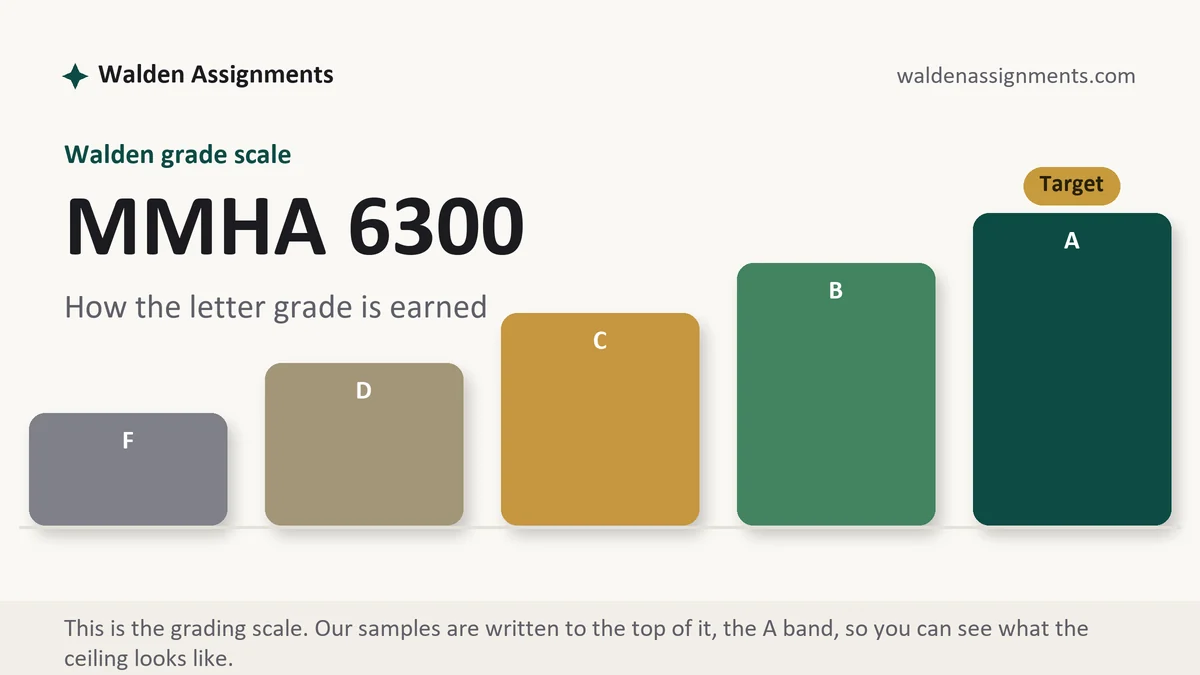
The MMHA 6300 drawers
MMHA 6300 Week 1 sources of law post example
The legal system's structure typically opens the course, sources of law argued in first posts. On request, free, 24-48h.
MMHA 6300 Week 2 administrative dilemma analysis example
Ethical frameworks often get their grounding week, principles applied to an administrative scenario. On request, free, 24-48h.
MMHA 6300 Week 3 corporate negligence analysis example
Negligence and malpractice usually arrive early-middle, elements walked through a facility fact pattern. On request, free, 24-48h.
MMHA 6300 Week 4 consent doctrine brief example
Consent and patient rights frequently anchor a case-analysis assignment, doctrine cited by name. On request, free, 24-48h.
MMHA 6300 Week 5 HIPAA breach memo example
Privacy weeks tend to work HIPAA hard, breach scenarios argued to the regulation's text. On request, free, 24-48h.
MMHA 6300 Week 6 EMTALA transfer analysis example
EMTALA and access duties often carry mid-course discussion, screening obligations applied to transfers. On request, free, 24-48h.
MMHA 6300 Week 7 fraud and abuse memo example
Fraud and abuse typically enter here, Stark and Anti-Kickback tested against physician deals. On request, free, 24-48h.
MMHA 6300 Week 8 workforce liability memo example
Employment, credentialing, and labor questions often take a week, liability traced to the organization. On request, free, 24-48h.
MMHA 6300 Week 9 ethics committee review example
Ethics committees and end-of-life policy frequently drive late discussion, values against duties. On request, free, 24-48h.
MMHA 6300 Week 10 fiduciary duty analysis example
A larger legal-ethical analysis usually builds now, one scenario argued under both lenses. On request, free, 24-48h.
MMHA 6300 Week 11 board ethics brief example
Final submissions typically close with the full analysis, every rule sourced, every recommendation defensible. On request, free, 24-48h.
Your classroom shows something else?
Walden revises courses; week counts and deliverables shift between sections. Send what your classroom shows and the desk matches it exactly.
Using a MMHA 6300 sample the right way
Read a 6300 sample the way a compliance officer reads a memo: check what authority every claim stands on. Notice how exemplar analyses cite the statute or case by name, state the rule's elements before applying them, and keep the ethics reasoning separate from the legal conclusion until the end. Then imitate the skeleton with your own scenario and current authority; regulations amend, and last year's HIPAA guidance may not be this year's. Never lift legal citations you have not checked. If your week's fact pattern is nothing like the shelved ones, send the prompt and rubric; the first matched sample is free, delivered in 24-48h.
How these samples are written
The discipline behind every paper here: the rubric is the outline, each row gets its section, discussions get the thread treatment with substantive replies, and the format layer ships exact. Send your classroom's rubric with a request and the sample matches it, revisions included.
MMHA 6300 questions, answered
How do I cite a statute in an APA paper without a law background?
Use APA's legal reference formats, which borrow from Bluebook: name the act, the U.S. Code citation, and the year, HIPAA appears as its Public Law or 45 C.F.R. sections for the rules. Walden's Writing Center keeps legal-citation examples. What matters to the rubric is that a named source exists and matches your claim; graders forgive imperfect formatting far faster than they forgive an uncited rule.
Is it enough to say an action was unethical and illegal?
No, that sentence is a conclusion wearing a costume. The paper earns points by showing which law makes it illegal, element by element against the facts, and which ethical principle makes it wrong, applied rather than announced. Split the two analyses, let them disagree if they honestly do, and recommend what the administrator should act on. Conclusions without demonstrated rules are the most common point loss in this course.
Which cases should I actually know for MMHA 6300 writing?
Know the doctrine your scenario touches rather than a canon. Corporate negligence usually traces to Darling v. Charleston Community Memorial Hospital; consent reasoning leans on Canterbury v. Spence; EMTALA and Stark questions cite the statutes themselves. When a prompt hands you a real case, brief that one. The rubric rewards the right authority for your facts, not the longest list of names.