Send the exact assignment or rubric from your classroom and a custom sample written to it lands in 24 to 48 hours, the first one free. NURS 6451 is Walden’s Evaluation Methods for Health Information Technology course. It centers on building an evaluation that could actually detect whether a health information system changed the work it was installed to change. Searches like "nurs 6451 week 4 assignment example", "NURS6451 sample paper", and "NURS 6451 week samples" land on this page.
What NURS 6451 is really about
Most NURS 6451 papers arrive as system descriptions wearing the word evaluation. They report what the technology does, who uses it, and how satisfied everyone seems, and none of that answers an evaluation question. An evaluation begins with something that could come out either way: did documentation time fall, did the alert change the order that followed it, did anyone open the module after training ended. Once the question is stated that plainly, the rest of the paper has work to do, because a measure has to be chosen, a data source located, and a comparison point named. Papers that skip the question end up measuring whatever the vendor already reports, which is adoption, and adoption is not effect.
The second thing this course teaches is that evaluation has a shape, and the shape depends on when you are asking. Formative work checks whether the build matches the workflow while there is still time to change it, and it lives on usability testing, observation and think-aloud sessions. Summative work asks whether the outcome moved after go-live, and it needs a baseline captured before anyone touched the system. Students who blur the two promise outcome data they cannot get, since the earlier period is gone. The rubric also expects unintended effects to be hunted deliberately, because a build that saves the nurse a few keystrokes and hands the pharmacist more work has saved nothing, and only a design that looks downstream would notice.
What NURS 6451’s assessments ask for
Weekly work here typically pairs a discussion thread, where you post an initial response and answer classmates, with a written Assignment that adds one piece to an evaluation you are building. Expect to state an evaluation question, defend a design against that question rather than by preference, name the measures and where each number would come from, and say who has to grant access before any of it happens. Where the classroom asks for literature, it wants studies that evaluated something similar, read for method rather than for conclusions. Later Assignments often ask what you would do with findings: who hears them, in what form, and which decision the report is supposed to enable. Fit between question, design and measure is read more closely than polish.
Where students lose points in NURS 6451
The most expensive loss is the paper that evaluates a system by describing it, which leaves every criterion about method with nothing to grade. Next is the measure chosen because it was available: survey satisfaction standing in for effect, login counts standing in for use, training completion standing in for competence. Points also go when a design is named and then contradicted, as when a paper claims a before and after comparison but never establishes what the earlier period looked like. Other steady leaks include stakeholders listed as a group rather than by the access or decision each controls, findings reported with no recipient, threats to validity acknowledged in one sentence and never answered, and a vendor white paper cited as evidence about the vendor's own product.
The NURS 6451 drawers
NURS 6451 Week 1 discussion post example
Week 1 often opens with a thread on what evaluation is and is not. On request, free, 24-48h.
NURS 6451 Week 2 evaluation question memo example
Week 2 usually narrows a broad worry into one question that could be answered. On request, free, 24-48h.
NURS 6451 Week 3 literature matrix example
Week 3 commonly reads prior evaluations for method rather than for their findings. On request, free, 24-48h.
NURS 6451 Week 4 evaluation design example
Week 4 frequently asks which design fits the question and what it cannot show. On request, free, 24-48h.
NURS 6451 Week 5 measurement plan example
Week 5 regularly attaches measures, sources and intervals to each question. On request, free, 24-48h.
NURS 6451 Week 6 usability analysis example
Week 6 generally turns to how real users fail at a screen. On request, free, 24-48h.
NURS 6451 Week 7 workflow impact analysis example
Week 7 routinely traces what the build did to work downstream of the user. On request, free, 24-48h.
NURS 6451 Week 8 stakeholder analysis example
Week 8 in many sections maps who controls access, who resists, and who decides. On request, free, 24-48h.
NURS 6451 Week 9 discussion post example
Week 9 in most sections debates unintended consequences and who notices them first. On request, free, 24-48h.
NURS 6451 Week 10 evaluation plan example
Week 10 typically pulls the pieces into one plan a department could run. On request, free, 24-48h.
NURS 6451 Week 11 reflection example
Week 11 often asks what your evaluation would change about your own practice. On request, free, 24-48h.
Your classroom shows something else?
Walden University revises courses; week counts and deliverables shift between terms. Send what your classroom shows and the desk matches it exactly.
Using a NURS 6451 sample the right way
Read a sample for the chain: question, design, measure, source, comparison. Follow one measure from the sentence where it is introduced to the sentence naming which system it would be pulled from and what it would be compared against, because that chain is what the rubric grades and it is what most drafts leave broken. Then rebuild it around technology you have actually watched people use, since the workflow detail cannot be borrowed and no sample can supply it. Notice as well how the finished paper treats a negative result as a finding rather than a failure, which is the register this course is training.
How these samples are written
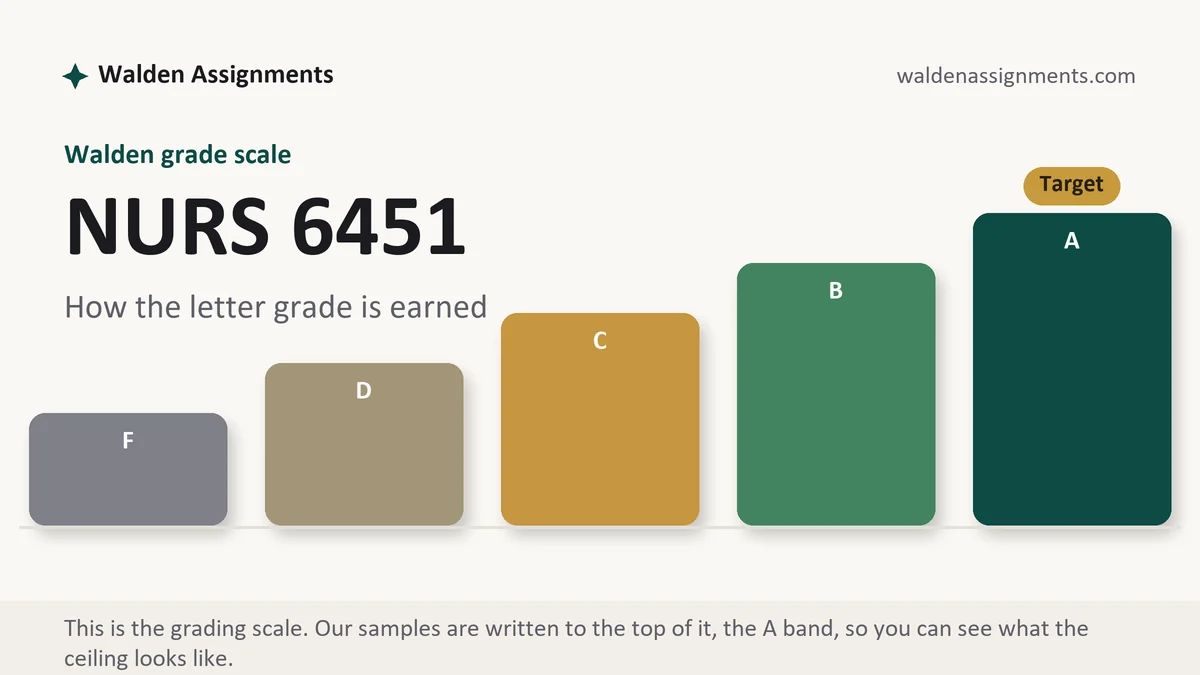
Every sample on this shelf is written the way the custom ones are: the rubric decoded row by row, a subject-matched writer drafting to the top band, formatting checked line by line. Walden revises classrooms, so a custom request is always written to the rubric in YOUR course, never from a stale template.
NURS 6451 questions, answered
Can I evaluate a system my employer uses?
Usually yes, and the workflow sections get much sharper when you do. Keep the organization unidentifiable, avoid anything that could expose patient information or a vendor contract, and write about the process rather than the site. If your workplace system is not usable for the Assignment, a published implementation case carries enough operational detail to reason about method.
Do I need real data to write an evaluation plan?
No. A plan is graded on whether the data could be obtained, not on whether you obtained it. Name the source, the field, the interval and who controls access, then say plainly what you would do if the extract turned out to be incomplete. An honest constraint written into the plan reads as method, while a missing source reads as an oversight.
How much technical detail belongs in these papers?
Enough to explain the effect, and no more. This course is about method and consequence rather than architecture, so a screen or an interface detail earns its place when it explains why a step gets skipped or a field gets filled wrongly. Long technical description crowds out the evaluation logic that the rubric is actually reading.