Send the exact assignment or rubric from your classroom and a custom sample written to it lands in 24 to 48 hours, the first one free. NURS 3030 is Walden’s Advocating for Diversity Equity and Inclusion in Healthcare course. It centers on diversity, equity, and inclusion as clinical advocacy, written as evidence-backed arguments about disparities and the actions nurses can take. Searches like "NURS 3030 week 4 assignment example", "NURS3030 sample paper", and "NURS 3030 week samples" land on this page.
What NURS 3030 is really about
NURS 3030 asks for a kind of writing many working nurses have never been graded on: advocacy with citations. The course moves through health disparities, cultural humility, and inclusive care, and every week converts those topics into deliverables, discussion posts that stake out a position and templated assignments that analyze a disparity or propose an advocacy step. The trap is register. Write too casually and it reads as opinion; write too cautiously and it reads as a book report. The rubric rewards the middle: a clear claim about an equity problem, evidence from the literature, and a concrete implication for practice. Nurses who have watched disparities play out at the bedside have the raw material; the course grades the shaping.
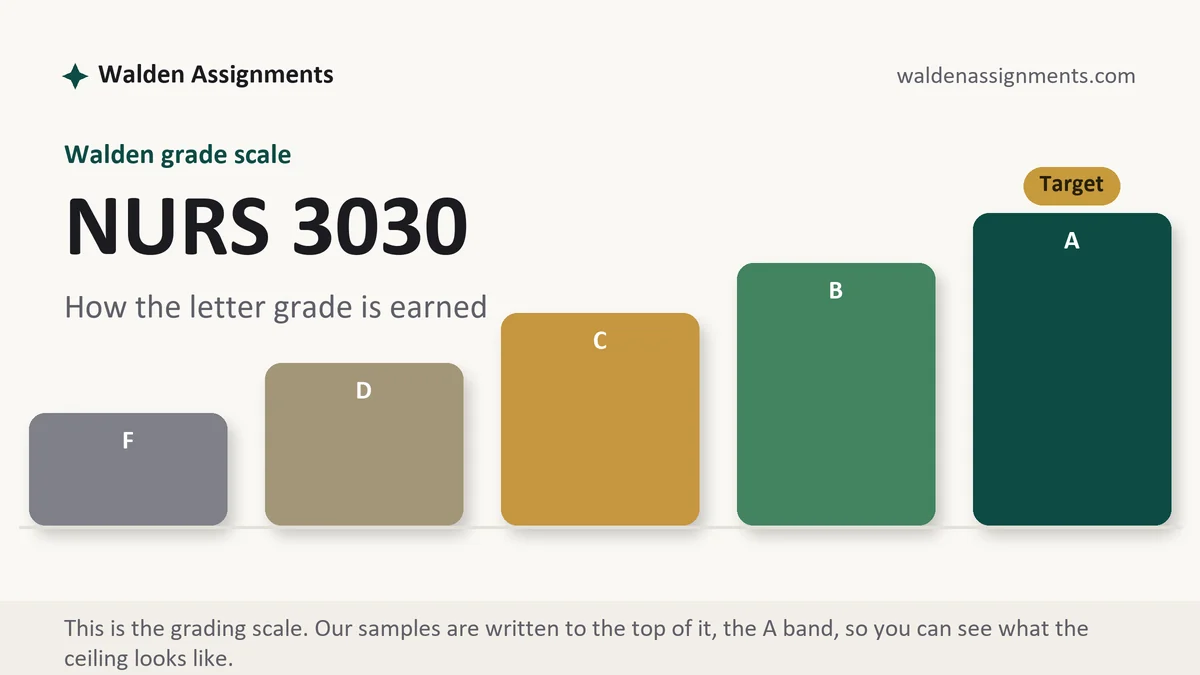
Weeks alternate familiar Walden structures. Discussions open with an initial post that takes a stance on the week's equity question and supports it from assigned readings plus outside sources, then peer replies that push the conversation somewhere new. Assignments arrive as Walden templates or short papers, often building toward an advocacy project across the later weeks. Points sit in named rubric rows, and the letter grade is assembled from all of them, participation included. In current classrooms instructors are careful graders of tone: sweeping claims without sources lose analysis points, and personal anecdotes score only when tied to evidence. The course is less about agreeing with the material than about arguing carefully inside it.
What NURS 3030’s assessments ask for
The deliverables ask you to argue about equity the way scholarship argues. Initial posts want a defined position on the prompt, at least one course reading cited, and a practice consequence named; most rubrics reserve separate points for each element. Peer replies are expected to extend, complicate, or respectfully challenge, and a reply carrying its own citation almost always outscores agreement. Templated assignments walk through disparity analysis: the population, the data behind the disparity, the contributing systems, and the nursing response, each in its own labeled section. Later weeks often assemble those pieces into an advocacy plan or presentation. APA 7 formatting applies everywhere, discussions included. Your classroom's rubric decides emphasis week to week, but evidence-plus-position is the constant demand.
Where students lose points in NURS 3030
NURS 3030 punishes summary harder than most courses because its prompts invite passion. An initial post that recaps the week's readings on disparities, without ever committing to a position, hands back the argument points the rubric set aside. Peer replies suffer a specific failure here: classmates agree enthusiastically because disagreement feels risky in an equity discussion, and the reply earns little because it extended nothing. Template assignments lose rows when the systems-level section gets a sentence while the personal-reflection section overflows, an imbalance graders notice immediately. The small rows, formatting, mechanics, reply timing, look too minor to chase and quietly cost a grade step over eleven weeks. And citations vanish from discussion posts as if conviction replaced APA, which no Walden rubric accepts.
The NURS 3030 drawers
NURS 3030 Week 1 equity vocabulary post example
First weeks usually open with introductions and a discussion defining equity terms in practice. On request, free, 24-48h.
NURS 3030 Week 2 caseload disparity post example
An early post often asks where disparities surface in your own patient population. On request, free, 24-48h.
NURS 3030 Week 3 cultural humility thread example
Cultural humility typically enters here, often as a discussion with cited peer replies. On request, free, 24-48h.
NURS 3030 Week 4 disparity data template example
Many sections assign a templated disparity analysis in this stretch, data required. On request, free, 24-48h.
NURS 3030 Week 5 social determinants position example
Social determinants often anchor the middle weeks, argued in posts and short papers. On request, free, 24-48h.
NURS 3030 Week 6 equity barrier template example
A midpoint assignment frequently examines one population's barriers through the course template. On request, free, 24-48h.
NURS 3030 Week 7 advocacy plan draft example
Advocacy planning tends to begin around now, sections drafted toward the final project. On request, free, 24-48h.
NURS 3030 Week 8 action feasibility thread example
Discussions in this stretch often test proposed actions against real practice constraints. On request, free, 24-48h.
NURS 3030 Week 9 stakeholder and policy revision example
Later weeks commonly refine the advocacy piece with stakeholder and policy considerations. On request, free, 24-48h.
NURS 3030 Week 10 final advocacy project example
The finished advocacy project or presentation typically comes due near here. On request, free, 24-48h.
NURS 3030 Week 11 advocacy reflection post example
The quarter often ends with a reflective post connecting advocacy to your practice. On request, free, 24-48h.
Your classroom shows something else?
Walden revises courses; week counts and deliverables shift between sections. Send what your classroom shows and the desk matches it exactly.
Using a NURS 3030 sample the right way
Send the prompt and rubric for the week and a custom NURS 3030 sample comes back in 24-48 hours, the first free. Use it to see how an equity argument holds its footing: a claim narrow enough to defend, data doing the persuading, a nursing action closing the loop. Notice how the sample fills every template section to proportion and cites inside discussion-length writing. Then argue your own position, from your own patient population, in that form. The sample is a model of shape and register, not a stand-in for your voice.
How these samples are written
Method, in one line: rubric first, structure from the rubric, evidence current, format exact. Discussion samples include the peer replies because Walden grades them; template weeks are filled field by field. Your free request is drafted against what your classroom actually shows.
NURS 3030 questions, answered
How do I take a strong position in a DEI discussion without sounding unprofessional?
Anchor every claim to evidence and aim it at systems, not colleagues. A post that says the data show an access gap and here is the nursing response reads as scholarship; a post that only expresses frustration reads as venting. The rubric grades argument quality, so let sources carry the heat.
My peer replies keep agreeing with classmates. Is that costing points?
Almost certainly. Agreement without extension is the most common reply failure in equity courses, because pushing back feels impolite. You do not have to disagree; you have to add. Bring a study, a counterexample from practice, or an implementation question. Rubrics pay for movement in the thread, not harmony.
The advocacy template sections overlap. Can I combine or shorten them?
Keep them separate and fill each to its weight. Overlapping sections are asking for different altitudes, one wants the population, another wants the system, another wants your action. Merging them collapses distinctions the rubric rows grade individually. A sample shows how the same disparity is treated differently section by section.