Send the exact assignment or rubric from your classroom and a custom sample written to it lands in 24 to 48 hours, the first one free. MRKT 3001 is Walden’s Marketing course. It centers on the decision to serve one group well rather than everyone poorly, and on describing that group tightly enough to act. Searches like "mrkt 3001 week 4 assignment example", "MRKT3001 sample paper", and "MRKT 3001 week samples" land on this page.
What MRKT 3001 is really about
Introductory marketing reads like a course about promotion, and first drafts usually get written that way: describe the product, list what is good about it, say who might like it. Graders in current classrooms want something narrower than that. The scored move in MRKT 3001 is exclusion, the sentence where a writer says this offer is built for these buyers and not for those. A description that fits everybody supports no decision, so it collects few points. Once the group is named tightly, the rest of the paper has somewhere to stand: a price can be argued against that group, a message can be addressed to it, a shelf or a screen can be chosen because it reaches them.
The second thing this course grades is whether the group you named can be found in the world. A segment built on attitude alone leaves a reader nothing to act with, so assignments push toward attributes someone could actually locate: where these buyers live, what stage of life they are in, what they already spend money on, what they do instead of buying from you. Published sources carry more weight here than beginners expect. An industry report or a public data page can hold up the description; your own sense of who would enjoy the product cannot, and rubrics treat that difference as the assignment itself rather than a formatting preference.
What MRKT 3001’s assessments ask for
Written work in MRKT 3001 arrives in small pieces before it arrives as one plan. Weeks typically carry a discussion post with replies, then a short applied paper tied to one product you picked early and kept: who its buyers are, one positioning sentence, a price argument, a message, a route to the buyer. Late weeks pull those pieces together, and the pulling is graded as heavily as the pieces were. Replies are graded writing too, not courtesy notes. What rubrics reward across all of it is specificity a reader could check. Naming the group, citing where the description came from, and saying plainly what the offer gives up in order to fit that group will lift a paper further than added length ever does.
Where students lose points in MRKT 3001
Points go missing in predictable places on this shelf. The group widens quietly between the middle weeks and the final plan until the audience is adults with disposable income, which is not a group at all. The price paragraph arrives with no reasoning attached to the buyers already described, so a reader cannot tell why that figure and not another. Sources sit in the reference list and never appear inside a sentence, which reads as decoration. The evidence has to sit where the claim is. Two more cost quietly: writing about a product category instead of one product, so nothing can be decided, and treating each week as a fresh start, so the plan ends up contradicting what earlier papers said about the same people.
The MRKT 3001 drawers
MRKT 3001 Week 1 discussion post example
Week 1 usually opens with a post on what marketing does beyond selling. On request, free, 24-48h.
MRKT 3001 Week 2 environment scan example
Week 2 often asks how outside forces change what a buyer will consider. On request, free, 24-48h.
MRKT 3001 Week 3 segmentation brief example
Week 3 commonly wants a group described by attributes a reader could go find. On request, free, 24-48h.
MRKT 3001 Week 4 positioning statement example
Week 4 generally pairs the chosen buyers with one positioning sentence and its rivals. On request, free, 24-48h.
MRKT 3001 Week 5 brand analysis example
Week 5 frequently examines a real brand's product decisions rather than its slogans. On request, free, 24-48h.
MRKT 3001 Week 6 pricing memo example
Week 6, in many sections, argues one price against what those buyers already pay. On request, free, 24-48h.
MRKT 3001 Week 7 channel note example
Week 7, as a rule, asks where the chosen buyer prefers to shop and why. On request, free, 24-48h.
MRKT 3001 Week 8 promotion plan example
Week 8, more often than not, builds a message aimed at that group alone. On request, free, 24-48h.
MRKT 3001 Week 9 digital brief example
Week 9 tends to move the same offer onto digital channels without softening the target. On request, free, 24-48h.
MRKT 3001 Week 10 peer reply example
Week 10 routinely turns to replies testing whether a classmate's group has real reach. On request, free, 24-48h.
MRKT 3001 Week 11 marketing plan example
Week 11 typically assembles the term's pieces into one plan with the exclusions intact. On request, free, 24-48h.
Your classroom shows something else?
Walden University revises courses; week counts and deliverables shift between terms. Send what your classroom shows and the desk matches it exactly.
Using a MRKT 3001 sample the right way
Work through a finished example from its last page forward. Find the sentence naming the buyer group, then walk back and watch how every earlier section was built to serve that one sentence. That structure is worth studying, and it stays invisible if you read forward. Check the citations next, noticing which claims were given a source and which were allowed to stand as reasoning. Your classroom's rubric, your instructor's product rules and your own chosen brand decide the rest, and they outrank anything modeled here. Submit your own work; a sample shows the shape of a scored argument and is not a draft missing a name.
How these samples are written
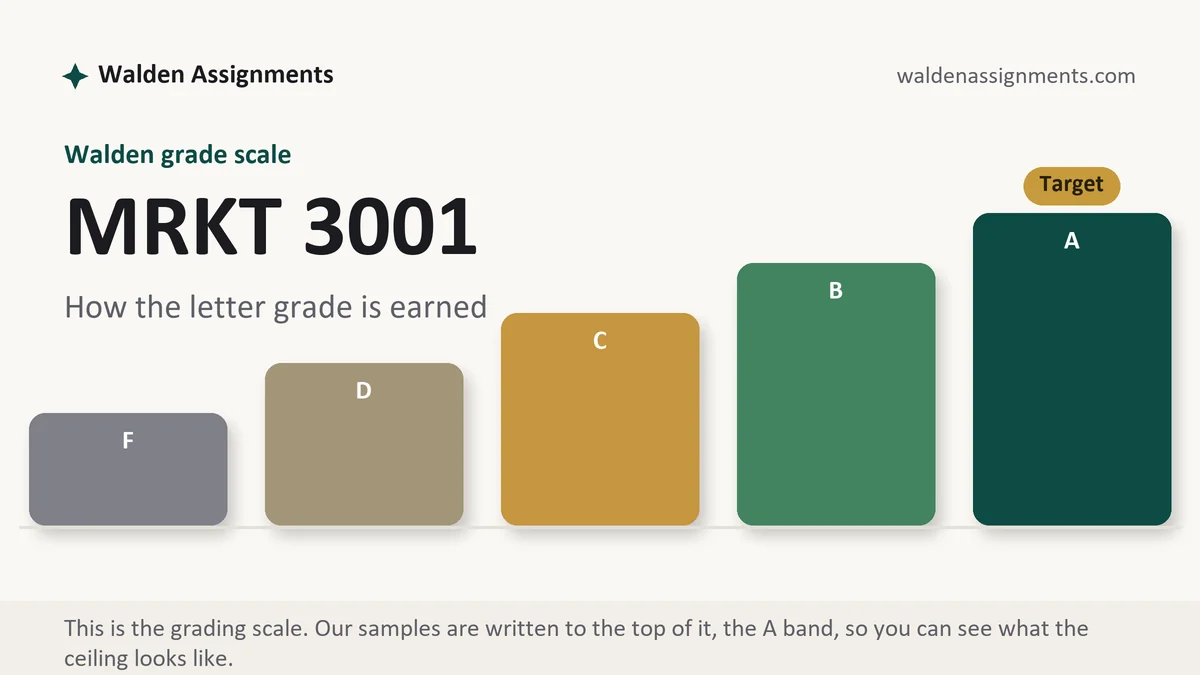
Every sample on this shelf is written the way the custom ones are: the rubric decoded row by row, a subject-matched writer drafting to the top band, formatting checked line by line. Walden revises classrooms, so a custom request is always written to the rubric in YOUR course, never from a stale template.
MRKT 3001 questions, answered
What kind of product should I pick for the term project?
One with published information behind it, and one narrow enough that decisions are possible. A single item from a real company works better than a whole category, because a category cannot carry a price or a message. Pick something whose buyers you are not part of, since writing about yourself usually produces a group of one and a grade that reflects it.
How specific does the target market description have to be?
Specific enough that a reader could go looking for those buyers without asking you a follow-up question. Age brackets and income bands alone rarely clear that bar. Add what the group already buys, where it shops, what it does instead, and where you learned that. The test applied is whether your next paragraph, on price or message, follows without a leap.
Do I have to use the marketing mix, or can I organize the paper my own way?
Follow the prompt posted in your classroom; when it names sections, those names are what the rubric scores against. The four-part mix shows up in introductory courses because it forces a decision in each area rather than a description. If your prompt leaves the organization open, keep the buyer group as the opening section anyway, since every later choice has to answer to it.