Send the exact assignment or rubric from your classroom and a custom sample written to it lands in 24 to 48 hours, the first one free. WMBA 6060 is Walden’s Marketing for Competitiveness course. It centers on choosing target segments with numbers attached and writing marketing strategies where positioning, pricing, and spend follow from that choice. Some program versions carry this course as WMBA 6060A and WMBA 5060; the same drawers apply. Searches like "WMBA 6060 week 4 assignment example", "WMBA6060 sample paper", and "WMBA 6060 week samples" land on this page.
What WMBA 6060 is really about
The course's title carries the thesis: marketing exists to make a business competitive, and every week of WMBA 6060 is judged by that standard. Topics move through customer analysis, segmentation and targeting, positioning, product and pricing choices, channels, and marketing communication, usually applied to one organization you carry across the term. The writing is strategy writing. A discussion post may ask which of two segments a firm should pursue and force you to defend the trade-off; assignments ask for analyses that end in allocation, this segment, this position, this price logic, this budget emphasis. Creativity is welcome and never sufficient; the rubric asks whether the choice would survive a revenue conversation.
Expect the eight weeks to build cumulatively toward a marketing plan or strategy paper, with earlier assignments producing its parts: a customer or market analysis, a segmentation and targeting decision, a positioning statement with support, then pricing, channel, and communication elements that stay consistent with the segment you chose. Initial posts and peer replies keep each element contested along the way, because classmates targeting different segments will read the same market differently. Walden's exemplar documents show the expected shape, but the differentiation is numerical: rough segment sizes, willingness-to-pay logic, acquisition assumptions. Working professionals who bring their own company's market usually finish with a plan they can actually use, which is the course working as designed.
What WMBA 6060’s assessments ask for
The recurring ask in WMBA 6060 is a choice with receipts. Analyze the market, then choose: name the target segment and show its size, growth, and fit in at least rough numbers. Position against named competitors, and keep the positioning claim testable rather than sloganized. Price with a logic the segment analysis supports, cost floor, value ceiling, competitor reference. Recommend channels and communication where the segment actually is, not where the budget is most fun to spend. Discussion prompts typically isolate one of these choices for argument, with peer replies expected to challenge the numbers behind classmates' picks. Rubrics reward internal consistency above all, a plan whose every element serves the same customer, and your classroom's rubric decides how heavily the quantitative support counts, though it always counts.
Where students lose points in WMBA 6060
Marketing plans in WMBA 6060 lose their points to missing arithmetic. The draft names a target, young professionals who value convenience, and never counts them: no segment size, no growth estimate, no revenue implication, no acquisition cost logic. Everything downstream then floats, because a price, channel, or campaign cannot be justified for a segment that was never quantified. Graders read such plans as mood boards and score the strategy rows accordingly. The second common leak is the everyone segment, a target so broad that positioning becomes impossible and the plan quietly contradicts itself, premium pricing for price-sensitive buyers, digital-first channels for an audience the paper called offline. Even rough, sourced arithmetic fixes both: a defended estimate of how many buyers, worth how much, reachable at what cost, turns the same ideas into a gradeable strategy.
The WMBA 6060 drawers
WMBA 6060 Week 1 customer value post example
Customer value and competitive framing often open week one's initial post and replies. On request, free, 24-48h.
WMBA 6060 Week 2 buyer profile analysis example
Market and customer analyses typically anchor week two for the organization you will carry forward. On request, free, 24-48h.
WMBA 6060 Week 3 sized targeting decision example
Segmentation and targeting decisions often land in week three, sized with defended estimates. On request, free, 24-48h.
WMBA 6060 Week 4 positioning claim defense example
Positioning statements tend to arrive mid-course, argued against named competitors and tested by peers. On request, free, 24-48h.
WMBA 6060 Week 5 price logic analysis example
Product and pricing analyses often carry week five, price logic tied to the segment. On request, free, 24-48h.
WMBA 6060 Week 6 channel and message map example
Channel and communication choices usually follow, matched to where the target actually buys. On request, free, 24-48h.
WMBA 6060 Week 7 integrated marketing plan example
The integrated marketing plan usually comes due in week seven, every element serving one customer. On request, free, 24-48h.
WMBA 6060 Week 8 competitive strategy retrospective example
Week eight often lands the finished plan plus a short retrospective on competitive strategy. On request, free, 24-48h.
Your classroom shows something else?
Walden revises courses; week counts and deliverables shift between sections. Send what your classroom shows and the desk matches it exactly.
Using a WMBA 6060 sample the right way
Open a WMBA 6060 sample to the segmentation section first and study how the numbers arrive: where the writer sourced a market size, how a rough estimate was defended, how the chosen segment then disciplined every later choice. That chain, count the segment, pick it, obey it, is the graded skill, and it transfers to any product or prompt. Your own plan must run on your own market's figures, so treat the sample as method, never as material. For a week this shelf does not match, send your assignment prompt and rubric; first custom sample free, in 24-48h.
How these samples are written
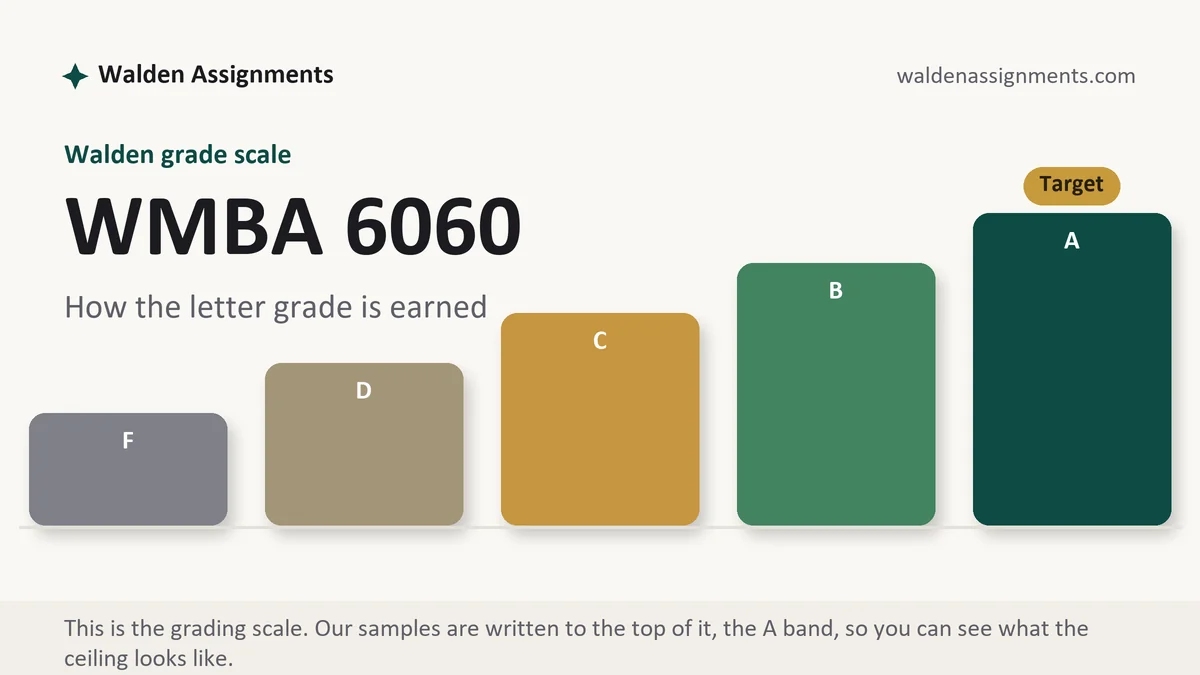
Every sample on this shelf is written the way the custom ones are: the rubric decoded row by row, a subject-matched writer drafting to the top band, formatting checked line by line. Walden revises classrooms, so a custom request is always written to the rubric in YOUR course, never from a stale template.
WMBA 6060 questions, answered
How much quantitative support does a WMBA 6060 marketing plan actually need?
Enough that every strategic choice has a number somewhere behind it: segment size or share for targeting, willingness-to-pay or competitor reference for pricing, reach or cost logic for channels. Sourced estimates and labeled assumptions are fine; absent figures are not. Plans written entirely in adjectives lose the strategy points no matter how polished the prose, so budget your effort toward the counting.
Where do I find segment numbers if my company or case gives none?
Build them in the open: census and industry data for the population, a sourced adoption or purchase rate, your own stated assumption for the rest, each labeled. Graders in current classrooms credit transparent estimation because it is the real-world skill; what draws feedback is a target chosen with no counting at all. One short assumptions paragraph usually carries the whole requirement.
Can my marketing plan target more than one segment?
Yes, if each segment gets its own arithmetic and its own treatment, and if the paper explains the priority between them. What fails is the unacknowledged multi-target: one broad audience described three different ways, with pricing serving one reading and channels another. Two counted segments beat one vague one; one counted segment beats both when the page limit is tight.