Send the exact assignment or rubric from your classroom and a custom sample written to it lands in 24 to 48 hours, the first one free. NURS 8301 is Walden’s Effectively Leading Organizations in Quality Improvement Initiatives course. It centers on leading quality improvement at organizational scale: improvement frameworks, change leadership, and measure-driven writeups that read as QI evaluation rather than research. Searches like "NURS 8301 week 4 assignment example", "NURS8301 sample paper", and "NURS 8301 week samples" land on this page.
What NURS 8301 is really about
NURS 8301 joins two literatures that DNP students usually meet separately: the mechanics of quality improvement and the leadership science of making organizations actually do it. Students work through improvement frameworks, PDSA logic, and measurement families, process, outcome, and balancing measures, while simultaneously analyzing culture, resistance, and the executive behaviors that determine whether an initiative survives its first quarter. The writing mirrors that pairing. A typical major assignment proposes an improvement initiative for a real setting and argues the leadership plan alongside the technical one. The doctoral register matters throughout: improvement work is framed as structured evaluation of change in one system, evidence moved into practice, and the course grades students on keeping that frame straight.
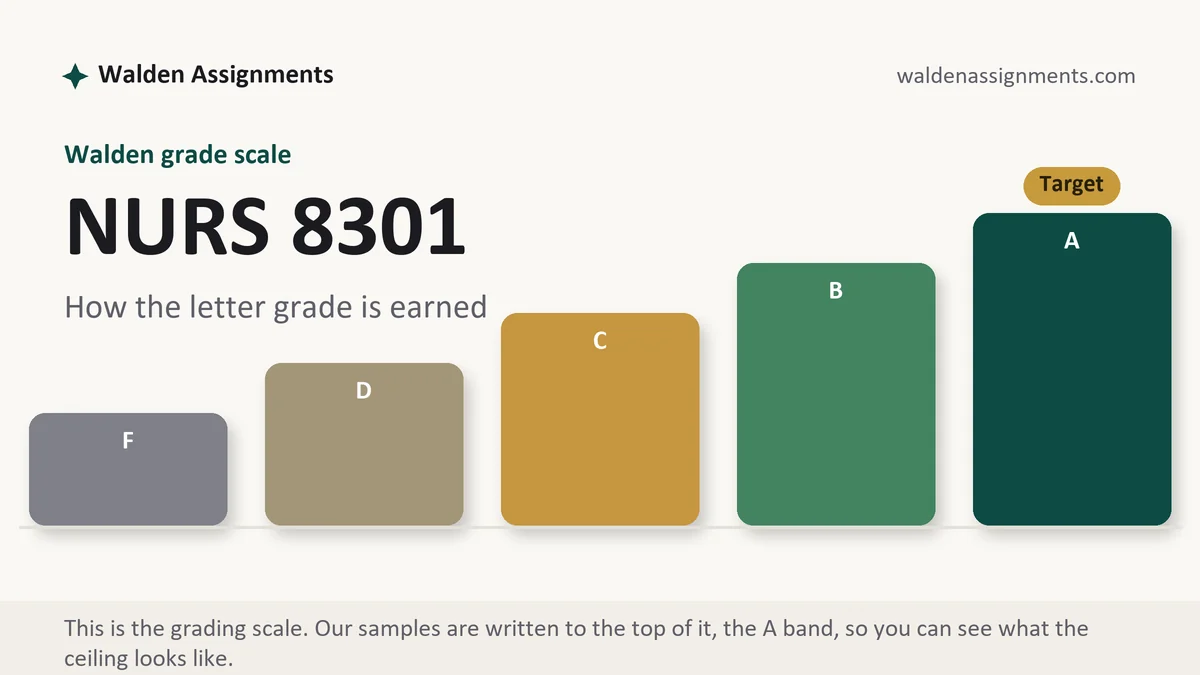
The eleven weeks typically alternate leadership discussions with staged QI writing. Discussion prompts often put students inside a failing initiative, asking what a doctoral leader does about stalled adoption or quiet sabotage, initial post and peer replies both argued from change literature. Assignments usually build a QI proposal in stages: problem and aim statement, framework selection, measure set with data plan, then the leadership and sustainment strategy. Rubrics in current classrooms score aim clarity, measure logic, and leadership specificity as separate threads, and letter grades follow the accumulation of weekly points. The shelf below tracks that arc drawer by drawer, with samples matched to the deliverable each week typically carries.
What NURS 8301’s assessments ask for
NURS 8301 assignments ask for precision in a genre with its own grammar. Aim statements must be specific, measurable, time-bound, and small enough to run: rubrics penalize aspirational aims that no PDSA cycle could touch. Framework sections ask why this model fits this problem, argued rather than asserted. Measurement sections expect process, outcome, and balancing measures with baseline sources named, and the writeup must describe change over cycles, what was predicted, what happened, what the team adapted. The leadership half asks for named strategies tied to the specific resistance a real setting would produce, not generic change theory recitation. Your classroom's rubric decides emphasis, but across sections the constant is register: this is QI evaluation prose, operational, iterative, and honest about attribution, and graders read for it from the first page.
Where students lose points in NURS 8301
The point-killer in NURS 8301 is the QI paper written as a research trial. Students reach for the vocabulary their earlier degrees rewarded: hypotheses, control groups, significance testing, generalizable findings. Graders mark it hard because the confusion is not stylistic: a trial asks whether an intervention works in principle; a QI writeup asks whether change is improvement in this system, tracked over cycles against a local baseline. Deductions follow for aim statements phrased as research questions, for claiming causality a before-after design cannot carry, and for burying iteration under a single static comparison. A parallel leak is leadership sections that describe frameworks without ever naming who resists and what the leader does Tuesday morning. The samples in these drawers keep cycle language, local attribution, and named leadership moves in every writeup.
The NURS 8301 drawers
NURS 8301 Week 1 improvement history thread example
Week 1 typically opens on quality's case history, a first discussion argued from improvement literature. On request, free, 24-48h.
NURS 8301 Week 2 improvement framework comparison example
Improvement frameworks often get compared this week, model fit argued for a chosen setting. On request, free, 24-48h.
NURS 8301 Week 3 QI problem and aim statement example
Many sections assign the problem and aim statement here, scoped small enough to run. On request, free, 24-48h.
NURS 8301 Week 4 QI culture readiness thread example
Organizational culture discussions typically follow, readiness and resistance argued with change theory sources. On request, free, 24-48h.
NURS 8301 Week 5 QI framework selection rationale example
A framework selection and justification paper often lands midcourse, choice defended against alternatives. On request, free, 24-48h.
NURS 8301 Week 6 driver diagram example
Measure-set assignments typically appear here, process, outcome, and balancing measures with baselines named. On request, free, 24-48h.
NURS 8301 Week 7 stalled adoption post example
Discussions frequently rehearse leading through stalled adoption, moves assigned to named roles. On request, free, 24-48h.
NURS 8301 Week 8 PDSA cycle plan example
Many classrooms assign the PDSA or cycle plan now, predictions written before tests of change. On request, free, 24-48h.
NURS 8301 Week 9 spread and sustainment thread example
Sustainment and spread strategies typically anchor late discussions, argued past the pilot's edge. On request, free, 24-48h.
NURS 8301 Week 10 executive QI proposal example
The full QI proposal often arrives here, technical plan and leadership plan in one document. On request, free, 24-48h.
NURS 8301 Week 11 QI leadership reflection example
Week 11 usually closes with reflection on improvement leadership and final proposal polish. On request, free, 24-48h.
Your classroom shows something else?
Walden revises courses; week counts and deliverables shift between sections. Send what your classroom shows and the desk matches it exactly.
Using a NURS 8301 sample the right way
Open a NURS 8301 sample at the aim statement and work outward. Notice the grammar: one measurable improvement, one system, one time frame, then measures that trace to it and cycles that revise it. That skeleton is what you carry into your own proposal; the content stays yours. Read the leadership sections for specificity technique, how the exemplar names resistance and assigns moves to a role, because that is the thread most drafts leave generic. Then audit your paper against your classroom's rubric. If your section's QI assignment uses a template or a named framework, send the prompt and rubric: the first custom sample is free, matched to those materials, delivered in 24-48h.
How these samples are written
The discipline behind every paper here: the rubric is the outline, each row gets its section, discussions get the thread treatment with substantive replies, and the format layer ships exact. Send your classroom's rubric with a request and the sample matches it, revisions included.
NURS 8301 questions, answered
My instructor commented that my QI proposal reads like a research study. What specifically needs to change?
Three moves usually fix it. Rewrite the aim as an improvement target for one system, not a research question about an intervention in general. Replace hypothesis and significance language with cycle language: predictions, tests of change, run data against baseline. Then soften causal claims to local attribution with limits stated. The register shift is what the rubric wants; our samples show it sentence by sentence.
Do I need balancing measures if my improvement aim is clearly beneficial?
Yes, and clearly beneficial is when graders look hardest. A balancing measure asks what your change might break elsewhere: faster discharge can raise readmissions, tighter documentation can slow care. Doctoral rubrics treat the absence as one-sided evaluation, the QI equivalent of reporting only the findings you liked. One well-chosen balancing measure with a data source usually carries the thread. The exemplars pair every aim with at least one.
Halfway through the staged proposal my aim statement changed. Should I just keep going?
Stop and reconcile first. A final proposal whose aim no longer matches the problem approved in your early weeks reads as drift, and QI graders check that alignment before anything else, because measures, cycles, and leadership plans all inherit their meaning from the aim. Revise the earlier language forward, note the refinement openly, and make every section answer the current aim. Our samples carry one aim, verbatim, across all stages.