Send the exact assignment or rubric from your classroom and a custom sample written to it lands in 24 to 48 hours, the first one free. NURS 8211 is Walden’s Data Collection and Analysis for Evidence-Based Practice course. It centers on practice data as project fuel: selecting measures, planning collection, running analysis suited to QI evaluation, and reporting findings with their limits. Searches like "NURS 8211 week 4 assignment example", "NURS8211 sample paper", and "NURS 8211 week samples" land on this page.
What NURS 8211 is really about
NURS 8211 exists because DNP projects live or die on data, and most clinicians have never had to defend a measurement choice in writing. The course covers the full chain: framing an answerable practice question, choosing measures with defensible validity, planning collection that a working unit could sustain, then analyzing and presenting what came back. The analytic register is deliberately doctoral-practice rather than research: descriptive statistics, run charts, and before-after comparisons that support operational decisions, with inferential tools introduced as aids to judgment rather than hypothesis verdicts. Assignments make students write each link of that chain, because the DNP project courses ahead will ask for exactly these sections under harder deadlines.
Weeks in NURS 8211 typically alternate concept discussions with staged data assignments. Early discussions often argue measurement basics, what makes an indicator valid on a real unit, initial post and peer replies both cited. Middle weeks usually carry the applied work: a measurement plan, a data collection tool or protocol, then an analysis assignment interpreting a dataset or the student's own practice numbers. Late weeks typically turn findings into presentation form, tables and narrative a stakeholder audience could act on. Rubrics score the reasoning around numbers as heavily as the numbers: why this measure, why this display, what the result does not show. The drawers below carry samples for each stage as it typically appears in current classrooms.
What NURS 8211’s assessments ask for
The assignments ask for auditable reasoning. A measurement plan must connect each proposed measure to the practice question, name its source and collection frequency, and admit its weaknesses before a grader does. Analysis assignments ask students to choose techniques that match the data's level and the question's purpose, then to write results in two registers at once: precise enough for a methods reader, plain enough for a unit council. Interpretation is graded hardest, because doctoral rubrics distinguish what the data show from what the student hoped, and reward stated limits over confident overreach. Every submission is also expected to account for where its data came from and under what permissions. Your classroom's rubric decides the weighting across those threads, but the accounting itself is never optional at this level.
Where students lose points in NURS 8211
The paper that loses points in NURS 8211 is the one that analyzes beautifully and never says how the data were obtained. Tables arrive clean, statistics run correctly, and the grader is left asking who approved the pull, whether patients were identifiable, where the file lives, and who else can open it. At the doctoral level that silence is not a formatting miss; it is an ethics gap, and rubrics score it as one. The second classic deduction is research cosplay: writeups that declare hypotheses, report p values as verdicts, and claim significance for a twelve-patient convenience sample, when the assignment wanted QI evaluation with honest limits. The samples here open every analysis with a data provenance and handling paragraph and let the interpretation stay inside what the numbers can hold.
The NURS 8211 drawers
NURS 8211 Week 1 practice data discussion example
Week 1 typically frames data's role in practice change, first discussion argued from EBP sources. On request, free, 24-48h.
NURS 8211 Week 2 indicator validity post example
Measurement validity and reliability discussions often follow, indicators judged against real unit conditions. On request, free, 24-48h.
NURS 8211 Week 3 question-to-measure map example
Many sections assign the practice question and early measure selection here, alignment stated plainly. On request, free, 24-48h.
NURS 8211 Week 4 data extraction plan example
Data collection planning typically lands this week, sources, frequency, and permissions written out. On request, free, 24-48h.
NURS 8211 Week 5 chart abstraction tool example
A collection tool or protocol assignment often appears midcourse, built for a working unit's tolerance. On request, free, 24-48h.
NURS 8211 Week 6 missingness and bias thread example
Discussions frequently weigh data quality problems, missingness and bias argued with examples. On request, free, 24-48h.
NURS 8211 Week 7 level-matched data displays example
Descriptive analysis work typically arrives here, displays matched to each measure's level. On request, free, 24-48h.
NURS 8211 Week 8 SPC analysis writeup example
Many classrooms assign the full analysis writeup now, provenance paragraph before any table. On request, free, 24-48h.
NURS 8211 Week 9 small-sample limits post example
Interpretation discussions often stress limits, what a small practice sample can and cannot claim. On request, free, 24-48h.
NURS 8211 Week 10 unit council data briefing example
Findings typically become a stakeholder presentation this week, numbers translated for a unit council. On request, free, 24-48h.
NURS 8211 Week 11 final data report example
Week 11 usually closes with a final data report and reflection on analytic readiness. On request, free, 24-48h.
Your classroom shows something else?
Walden revises courses; week counts and deliverables shift between sections. Send what your classroom shows and the desk matches it exactly.
Using a NURS 8211 sample the right way
Use a NURS 8211 sample to learn the order of operations, not to borrow numbers. Watch how the exemplar introduces its data before analyzing it, provenance, permissions, and handling first, because that opening paragraph is the cheapest points on the rubric and the most often skipped. Study how each display is chosen to match the measure, then rebuild the sequence with your own dataset and your own practice question. Check the draft against your classroom's rubric before submission. If your section hands you a specific dataset or template, send the assignment prompt and rubric with it: first custom sample free, written to those exact materials, back in 24-48h.
How these samples are written
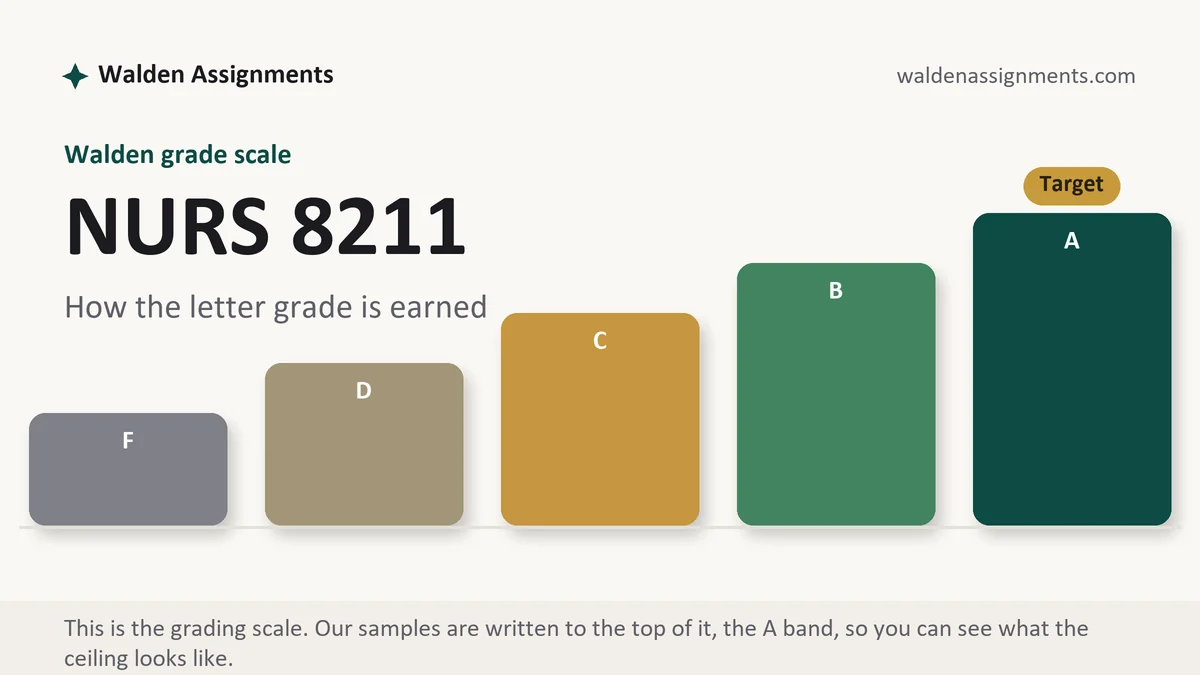
Every sample on this shelf is written the way the custom ones are: the rubric decoded row by row, a subject-matched writer drafting to the top band, formatting checked line by line. Walden revises classrooms, so a custom request is always written to the rubric in YOUR course, never from a stale template.
NURS 8211 questions, answered
Do I really need an ethics section in a course data assignment that uses unit numbers I already have access to?
Yes, and access is exactly why. Having the keys to a dashboard is not the same as permission to analyze it in coursework. Doctoral graders expect a short account: data source, whether identifiers were removed, who authorized use, and how the file is stored. Two or three sentences usually satisfy the rubric thread. Our samples model that paragraph so it becomes reflex before the project courses.
My analysis found no statistically significant change. Did my assignment fail?
No. This course grades reasoning, and QI evaluation is not hypothesis testing: a small practice sample was never going to power a verdict, and writing as if it could is the actual error. Report the direction and size of change, the operational meaning, and the limits, then say what a unit should do next. Rubrics reward that honesty over a manufactured significance claim every time.
Can my measurement plan reuse the practice question from my earlier DNP courses?
Reuse the question, but keep its wording exact. Continuity across courses is a strength; what costs points is drift, a measurement plan whose measures quietly answer a broader or narrower question than the one stated at the top. Graders check that alignment first. Carry the approved wording forward, then let every measure trace to it visibly. The exemplars show that traceability as a table.