Send the exact assignment or rubric from your classroom and a custom sample written to it lands in 24 to 48 hours, the first one free. NURS 8114 is Walden’s Theoretical and Scientific Foundations of Nursing course. It centers on the scientific and theoretical scaffolding of doctoral practice: selecting nursing frameworks and defending their fit to a specific practice problem. Some program versions carry this course as NURS 8112; the same drawers apply. Searches like "NURS 8114 week 4 assignment example", "NURS8114 sample paper", and "NURS 8114 week samples" land on this page.
What NURS 8114 is really about
NURS 8114 answers the question doctoral students least expect to face: on what scientific ground does nursing practice stand? The course moves through philosophy of science, the structure of nursing knowledge, and the families of theory, grand, middle-range, and practice-level, then makes students do something with them. The recurring task is fit: take a real practice problem and show that a chosen framework explains its mechanisms, predicts what an intervention should change, and supplies the concepts an evaluation would measure. That is translation science in miniature, and it is why the course sits early in the DNP sequence. A framework defended well here typically follows the student into the project courses.
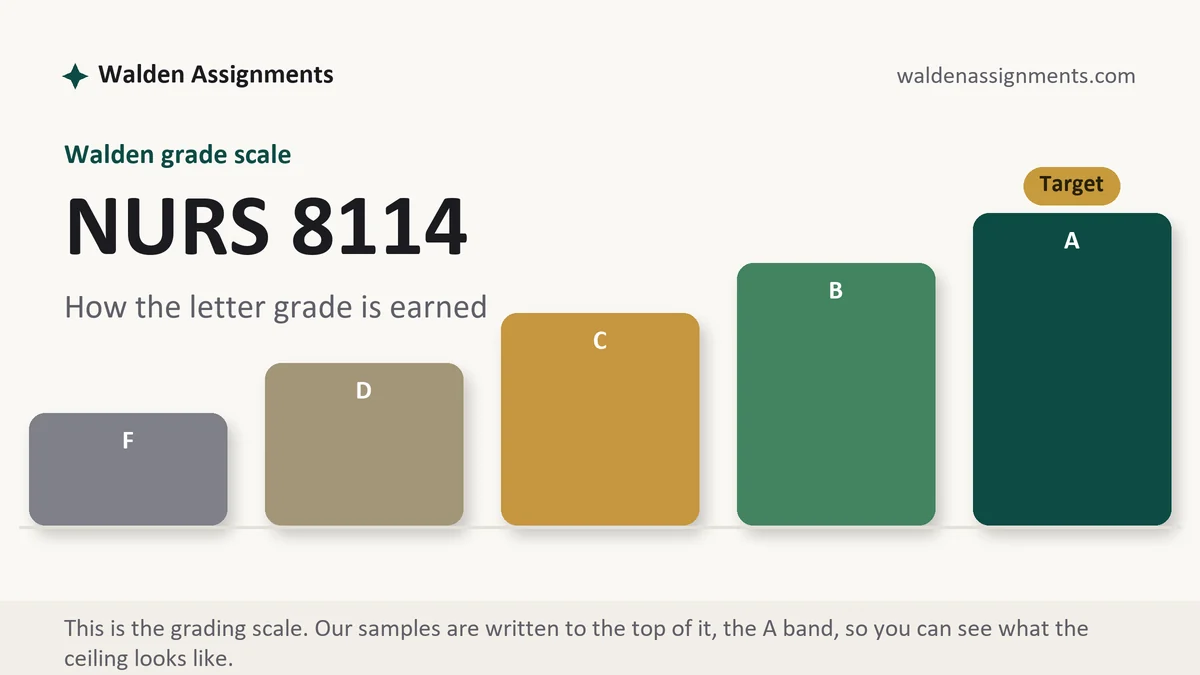
The eleven-week rhythm mixes reading-heavy discussions with staged writing. Early weeks typically run discussion posts on ways of knowing and the philosophy behind evidence, initial post and peer replies both scored. The writing arc usually selects a practice problem, surveys candidate theories, then commits to one framework in a formal application paper that maps its concepts onto the problem's moving parts. Rubrics in current classrooms score theoretical accuracy hard: misstating a theorist's concepts costs more than thin analysis elsewhere, which is why citations to primary theoretical sources rather than textbook summaries matter in this course specifically. Letter grades accumulate from those weekly points, and the shelf below matches samples to each stage.
What NURS 8114’s assessments ask for
What NURS 8114 grades is argued fit, not framework name-dropping. Discussion prompts typically ask students to compare ways of knowing or defend the scientific status of nursing knowledge, positions carried by sources rather than conviction. The application papers ask for a specific sequence: state the practice problem, introduce the framework from its primary source, define its concepts precisely, then map each concept onto an element of the problem until the theory visibly explains the situation and points toward measurable change. Doctoral rubrics also expect propositional language, what the theory predicts, stated as testable relationships between concepts. Your classroom's rubric decides thread weights, but accuracy of the theory account, tightness of the mapping, and APA discipline are scored everywhere, and the mapping is where strong papers separate from adequate ones.
Where students lose points in NURS 8114
Theory papers in NURS 8114 lose points in two characteristic ways, and both are drift. The first is problem drift: the practice problem described in the framework paper is no longer the one the student proposed earlier, so the carefully argued fit now explains a situation the course never approved. The second is decorative theory: a framework introduced in the opening paragraphs and never consulted again, while the paper's actual reasoning runs on common sense. Graders test for it by checking whether removing the theory would change any later sentence; too often it would not. Secondhand theory is the third leak, definitions quoted from textbooks that flatten the theorist's own terms, which doctoral rubrics score as inaccuracy. The samples here keep one problem, one framework, and primary-source definitions in continuous contact from aim to conclusion.
The NURS 8114 drawers
NURS 8114 Week 1 patterns of knowing post example
Week 1 typically opens on ways of knowing in nursing, argued in an initial post with peer replies. On request, free, 24-48h.
NURS 8114 Week 2 disciplinary knowledge post example
Philosophy-of-science discussions often follow, positions on nursing's disciplinary knowledge defended from assigned readings. On request, free, 24-48h.
NURS 8114 Week 3 theory-ready problem description example
Many sections ask for a practice-problem description here, the anchor later theory work must fit. On request, free, 24-48h.
NURS 8114 Week 4 grand versus middle-range post example
Grand versus middle-range theory comparisons typically fill this week's posts, differences argued with examples. On request, free, 24-48h.
NURS 8114 Week 5 framework selection analysis example
A theory selection assignment often lands midcourse, candidate frameworks weighed against the stated problem. On request, free, 24-48h.
NURS 8114 Week 6 borrowed theory adaptation post example
Discussions in many classrooms probe borrowed theory, what nursing may import and what it must adapt. On request, free, 24-48h.
NURS 8114 Week 7 theoretical concept definitions example
Concept definitions drawn from primary theoretical sources typically anchor this week's writing. On request, free, 24-48h.
NURS 8114 Week 8 framework-to-problem mapping example
The framework application paper often arrives here, each concept mapped onto the practice problem. On request, free, 24-48h.
NURS 8114 Week 9 concept operationalization post example
Late discussions frequently connect theory to measurement, which concepts an evaluation could actually observe. On request, free, 24-48h.
NURS 8114 Week 10 theoretical foundation statement example
Many sections assign a full theoretical foundation paper now, propositions stated in translation terms. On request, free, 24-48h.
NURS 8114 Week 11 theory-to-project reflection example
Week 11 usually closes with reflection on theory's place in the coming DNP project work. On request, free, 24-48h.
Your classroom shows something else?
Walden revises courses; week counts and deliverables shift between sections. Send what your classroom shows and the desk matches it exactly.
Using a NURS 8114 sample the right way
Treat a NURS 8114 sample as a demonstration of mapping technique. Notice how the exemplar defines each theoretical concept before using it, and how every definition cites the theorist's primary work rather than a survey text; replicate that citation habit with your own framework. Then trace the mapping table or paragraphs where concept meets practice problem, because that structure transfers to any theory the assignment hands you. Write your paper against your own problem and check the result against your classroom's rubric. If your section's prompt asks for something the drawers do not hold, send it with the rubric: first custom sample free, 24-48h, written to your exact framework and problem.
How these samples are written
The discipline behind every paper here: the rubric is the outline, each row gets its section, discussions get the thread treatment with substantive replies, and the format layer ships exact. Send your classroom's rubric with a request and the sample matches it, revisions included.
NURS 8114 questions, answered
My framework paper describes a slightly different practice problem than my earlier discussions did. Is that a real problem?
It is the deduction most students never see coming. Graders read your submissions as one developing argument, and a problem that mutates between weeks makes the framework fit unverifiable: fit was argued to a problem that no longer exists. Reconcile the wording before submitting, or state the refinement openly in the paper. Our samples restate the identical problem sentence in every deliverable.
Should my theory application paper state hypotheses the way a research study would?
No. State propositions, what the framework predicts about relationships between its concepts, and connect them to changes a practice project could observe. Hypothesis language implies you are designing a trial, and this course is preparing you to translate and evaluate, not to test under controlled conditions. Doctoral graders mark the register difference. The exemplars phrase predictions as theory-driven expectations for practice outcomes.
Can I switch frameworks after my theory selection paper has been graded?
You can, but treat it as a formal amendment, not a quiet swap. Later papers that cite a different framework than the one you defended read as drift, and graders score the mismatch even when the new theory fits better. If the change is genuinely justified, open the next paper by naming the switch and the reason. Our samples carry one framework through every stage precisely to show what consistency earns.