Send the exact assignment or rubric from your classroom and a custom sample written to it lands in 24 to 48 hours, the first one free. INHE 1001 is Walden’s Introduction to Biology course. It centers on turning descriptions of living systems into explanations, where each stated outcome is traced back to the process producing it. Some program versions carry this course as BIOL 1001; the same drawers apply. Searches like "inhe 1001 week 4 assignment example", "INHE1001 sample paper", and "INHE 1001 week samples" land on this page.
What INHE 1001 is really about
A first biology course looks like vocabulary from the outside, and students who treat it that way hand in papers that name everything and account for nothing. The term is really an apprenticeship in one sentence shape: this happens because that acts on this. Photosynthesis is not a word waiting to be defined; it is a sequence in which light energy is captured, carried by a molecule, and spent building sugar, and a paper earns its marks at the joints of that sequence. Sections vary in which systems they cover and in what order the weeks arrive. The underlying demand holds steady across all of them. Say what causes the thing you have just described.
The second habit the term builds is level discipline. Living things can be described as molecules, as cells, as tissues, as whole organisms and as populations, and an account goes wrong the moment it swaps one level for another without saying so. A trait that runs in a family is a population-level observation, the gene behind it is a molecular one, and the protein that gene specifies is what connects them; skipping that middle step leaves a hole a reader will find. Purpose language causes the same trouble. Cells do not want anything, and writing that they do quietly replaces a mechanism with a motive. Name the step, name what performs it, and the sentence stops needing intention.
What INHE 1001’s assessments ask for
In a given week the thread and the short paper answer to separate standards, which catches students who prepare for both the same way. The thread wants a position stated and then defended when somebody asks why, which is why replies that only agree earn very little. Written work runs short and is judged on density: one page carrying four causal steps beats three pages carrying none. The recurring demands are a phenomenon described accurately, a process named at the right level, a chain of steps that gets from one to the other without a jump, and a source that is a study or a text rather than a summary of one. Figures help, though only when the prose around them says what the arrows mean.
Where students lose points in INHE 1001
Restatement is the most expensive habit in this course. A paragraph that says enzymes speed reactions, then says it again with fresh adjectives, has described the phenomenon twice and explained it zero times. Marks also go for purpose language, where a structure is said to want or to try; for jumps between levels, where a whole-organism trait is credited straight to a molecule with nothing in between; for a news article standing in where the study it summarized was expected; for wording copied close enough to its source that the borrowing shows; for terms used confidently but slightly off, since precision is part of the grade here; and for peer replies that compliment a post instead of asking what drives the process it names.
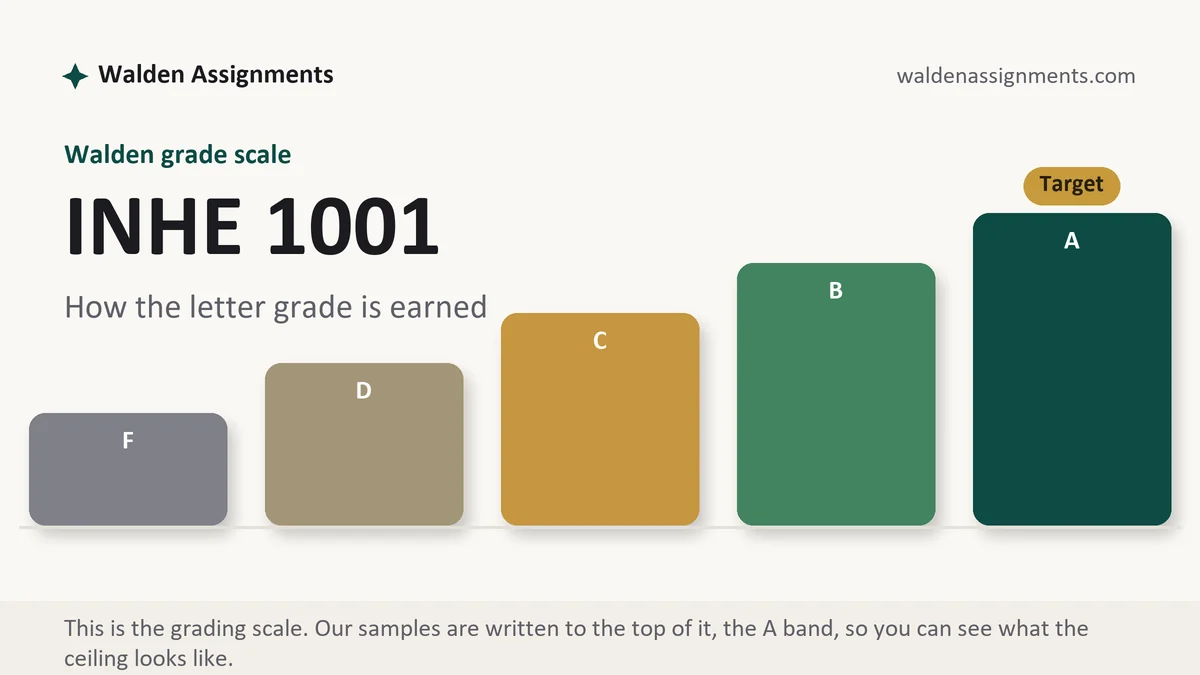
The INHE 1001 drawers
INHE 1001 Week 1 levels of organization post example
Week 1 often opens with a thread placing one familiar organism at several levels at once. On request, free, 24-48h.
INHE 1001 Week 2 cell structure explanation example
Week 2 typically asks what a named cell part does, not merely where it sits. On request, free, 24-48h.
INHE 1001 Week 3 hypothesis and prediction set example
Week 3 usually turns a loose question into a testable statement with a prediction attached. On request, free, 24-48h.
INHE 1001 Week 4 energy pathway walkthrough example
Week 4 commonly follows energy from sunlight or food through the steps that store it. On request, free, 24-48h.
INHE 1001 Week 5 experiment critique example
Week 5 often hands over a study design and asks which control is missing. On request, free, 24-48h.
INHE 1001 Week 6 inheritance problem set example
Week 6 typically works crosses and then asks what the ratios reveal about genes. On request, free, 24-48h.
INHE 1001 Week 7 causal chain paper example
Week 7 usually wants one outcome traced backward through every step that produced it. On request, free, 24-48h.
INHE 1001 Week 8 adaptation argument example
Week 8 often asks why a trait spread, with selection pressure named rather than assumed. On request, free, 24-48h.
INHE 1001 Week 9 nutrient cycle trace example
Week 9 commonly follows one element around an ecosystem and back into living tissue. On request, free, 24-48h.
INHE 1001 Week 10 peer mechanism challenge example
Week 10 typically rewards replies asking a classmate what actually drives the effect described. On request, free, 24-48h.
INHE 1001 Week 11 final mechanism paper example
Week 11 usually closes the term with a single explanation carried end to end. On request, free, 24-48h.
Your classroom shows something else?
Walden University revises courses; week counts and deliverables shift between terms. Send what your classroom shows and the desk matches it exactly.
Using a INHE 1001 sample the right way
Take a sample apart before you take anything from it. Mark every sentence that carries a because, whether stated or implied, and notice how few sentences that leaves; the rest are there to set those up. Then check where each explanation sits on the ladder from molecule to population, and whether the sample changes rungs on purpose or by accident. What transfers is that shape rather than the content, since your section will cover different systems anyway. Write your own from your own reading and the rubric your classroom posted. We hand you a worked example; the argument you submit has to be yours.
How these samples are written
Method, in one line: rubric first, structure from the rubric, evidence current, format exact. Discussion samples include the peer replies because Walden grades them; template weeks are filled field by field. Your free request is drafted against what your classroom actually shows.
INHE 1001 questions, answered
Is a sample useful when my section covers different topics than the one shown?
Yes, because what is on display is the reasoning shape rather than the subject matter. A paper explaining muscle contraction and a paper explaining membrane transport are built alike: a stated outcome, the structure responsible, and the ordered steps between them. Once you can see that skeleton in one topic you can set your own topic on it. The topic is the variable; the skeleton is not.
How much detail belongs in an introductory paper?
Enough to leave the chain unbroken, and no more. If a reader can follow every step from the starting condition to the result without supplying anything themselves, the level is right. Detail sitting outside that chain is padding, however accurate it happens to be. Most first drafts fail the opposite way, stopping one step short and leaving the reader to guess the connection that mattered most.
My instructor keeps writing so what in the margin. What does that mean here?
It usually means the sentence stopped at the observation. You reported that a rate rose or that a structure exists, and the reader waited for a consequence and never got one. The repair is rarely more words. It is one more link: what the observation causes, or what it rules out. Adding that link is what turns a report into an explanation.