Send the exact assignment or rubric from your classroom and a custom sample written to it lands in 24 to 48 hours, the first one free. HLTH 8750 is Walden’s Trends and Issues in Executive Level Management for Healthcare Administrators course. It centers on reading a shift early enough to matter, and on defending a commitment made while the evidence is still open. Some program versions carry this course as DDHA 8750 and HCAD 8750; the same drawers apply. Searches like "hlth 8750 week 4 assignment example", "HLTH8750 sample paper", and "HLTH 8750 week samples" land on this page.
What HLTH 8750 is really about
Everything in this course happens before the evidence is complete. An executive who waits for the literature to settle is reading about a change that competitors already priced in two years ago, and one who moves on every headline burns the organization's credibility along with its attention. The paper is an exercise in that judgment. It has to establish that something is actually shifting, using sources that were published while the shift was underway, then say what a specific organization should do about it, and then, hardest of all, state what would have to happen for that call to be wrong. Rubrics reward the last part more than writers expect.
The failure mode is the trend piece that reads like a trade magazine. Three shifts get named, each described in a paragraph, all of them called significant, and the organization never appears. What a doctoral reader wants instead is one shift examined closely enough to be doubted, with the evidence weighted by how it was gathered and by how old it is. Industry commentary can show what practitioners believe; it cannot establish that a change is real. Pair it with peer reviewed work and public data, then be explicit about the part of your claim that rests on judgment rather than evidence, because pretending the whole argument is proven is what costs the points.
What HLTH 8750’s assessments ask for
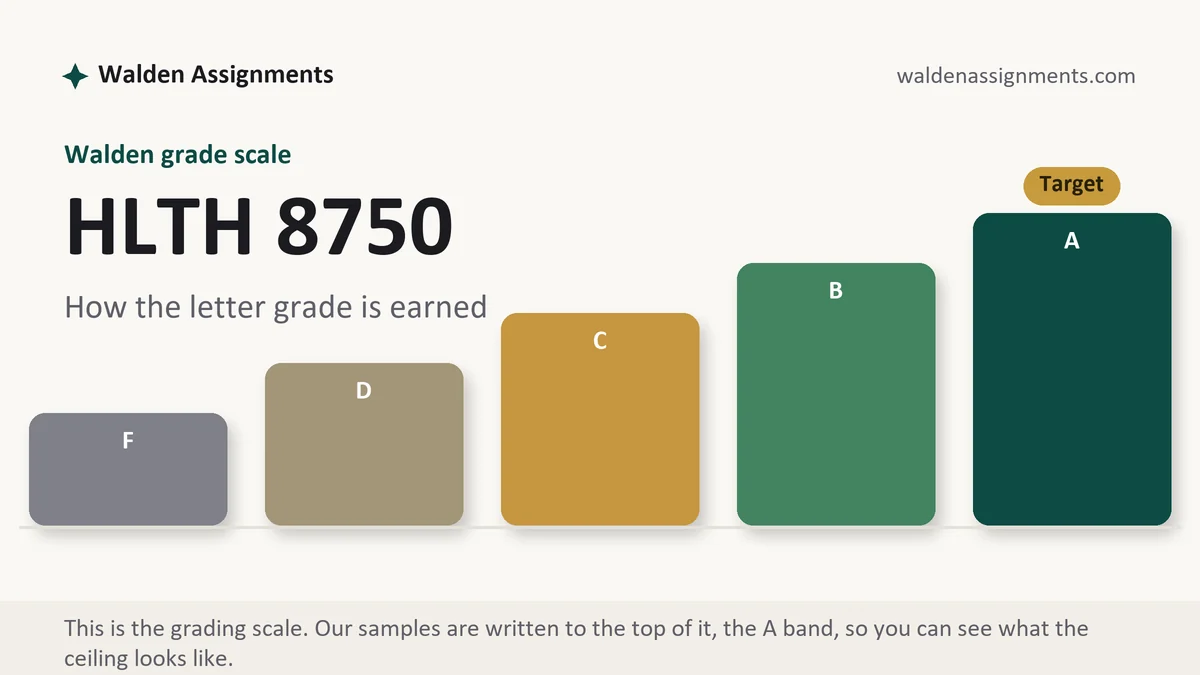
A week in HLTH 8750 tends to ask for a short public position and a longer defended one. The discussion wants a claim about a current shift, stated without hedging in the initial post, and replies that ask what a classmate's reading would look like if the underlying numbers turned. The written work asks for a trend established from dated evidence, an organization concrete enough to have constraints and a history, an argument about what that organization should do and when, the case for waiting instead, and a statement of the signals that would tell an executive the call was wrong. Marks in current classrooms usually track the evidence behind the trend, the position taken, the treatment of uncertainty, and mechanics.
Where students lose points in HLTH 8750
The costliest habit is reporting the news. A paper that says what is happening in the sector, accurately and without a position, has written a briefing and skipped the assignment. Second is the undated source, where a claim about where things are heading rests on work published before the change began. Third is false confidence: a forecast delivered flat, with no range, no condition and no acknowledgment that the writer could be reading it wrong, which reads as inexperience rather than authority. Fourth is the position with no cost, where the organization is told to move and nobody asks what it gives up, what it delays, or who has to be convinced. Mechanics and citation errors finish the list.
The HLTH 8750 drawers
HLTH 8750 Week 1 framing post example
Week 1 frequently asks how an executive tells a trend from a bad quarter. On request, free, 24-48h.
HLTH 8750 Week 2 discussion post example
Week 2 threads regularly argue which shift the sector is underrating right now. On request, free, 24-48h.
HLTH 8750 Week 3 evidence scan example
Week 3, more often than not, weighs sources by how far behind the change they run. On request, free, 24-48h.
HLTH 8750 Week 4 trend brief example
The week 4 paper, for the most part, takes a position on a trend still unsettled. On request, free, 24-48h.
HLTH 8750 Week 5 scenario analysis example
Week 5 typically asks what the organization does if the predicted shift never arrives. On request, free, 24-48h.
HLTH 8750 Week 6 peer critique example
Week 6 replies often ask what evidence would make a classmate abandon their forecast. On request, free, 24-48h.
HLTH 8750 Week 7 workforce analysis example
Week 7 usually examines a workforce shift and how long it takes to feel it. On request, free, 24-48h.
HLTH 8750 Week 8 discussion post example
Week 8 discussions commonly weigh moving before a regulation lands against waiting for certainty. On request, free, 24-48h.
HLTH 8750 Week 9 commitment memo example
Week 9 generally asks when a commitment stops being reversible and who knew that. On request, free, 24-48h.
HLTH 8750 Week 10 counterargument brief example
Week 10, as a rule, wants the argument that the trend you backed will fade. On request, free, 24-48h.
HLTH 8750 Week 11 position paper example
Week 11, in many sections, ends with a position an executive would defend to a board. On request, free, 24-48h.
Your classroom shows something else?
Walden University revises courses; week counts and deliverables shift between terms. Send what your classroom shows and the desk matches it exactly.
Using a HLTH 8750 sample the right way
Read a sample for its timing. Note when the sources were published relative to the change being described, and watch how the writer converts a shift into something an organization does on a date. The paragraph worth studying is the one admitting what would falsify the call, because that is the move most drafts skip and most rubrics reward. Your assignment prompt and rubric set length, sources and format, and a sample answers to them. Write the paper yourself, and if your own organization is weighing this decision, argue from public evidence and leave the internal discussion where it belongs.
How these samples are written
Every sample on this shelf is written the way the custom ones are: the rubric decoded row by row, a subject-matched writer drafting to the top band, formatting checked line by line. Walden revises classrooms, so a custom request is always written to the rubric in YOUR course, never from a stale template.
HLTH 8750 questions, answered
How current do the sources have to be?
Current enough to be about the change itself. A paper arguing that something is shifting needs work published while it was shifting, which usually means recent peer reviewed studies alongside regulatory filings and industry reporting. Older sources still earn their place when they establish the baseline the trend departs from, and saying that out loud is what makes the reference list look deliberate.
Can I write about a trend that turns out to be wrong?
Yes, and it is not the risk writers think. The rubric grades the reasoning, the evidence and the honesty about uncertainty, not whether the future cooperates. A paper that takes a clear position, shows what it rests on, and names the conditions under which it fails will outscore a cautious survey that commits to nothing at all.
Does the paper need to name a real organization?
It needs an organization with real constraints, which is not the same thing. A described system with a stated size, service area and financial pressure gives the argument something to push against, and it avoids the problem of writing publicly about an employer's plans. Where a prompt does ask for a named organization, stay with what that organization has published about itself.