Send the exact assignment or rubric from your classroom and a custom sample written to it lands in 24 to 48 hours, the first one free. HLTH 8317 is Walden’s Financing Public Health Systems course. It centers on how public health work gets paid for, and on what each funding stream quietly forbids the agency that accepts it. Some program versions carry this course as PUBH 8317; the same drawers apply. Searches like "hlth 8317 week 4 assignment example", "HLTH8317 sample paper", and "HLTH 8317 week samples" land on this page.
What HLTH 8317 is really about
Financing here is a structural subject, not an arithmetic one. The question a strong paper asks is not how much an agency spends but where the money entered the system and what came attached to it. A categorical grant buys one activity and forbids the neighboring one. An appropriation lives or dies on a reauthorization calendar that has nothing to do with need. A fee follows the people who can pay it. Once a writer sees a program as the sum of those origins, the analysis stops being descriptive and starts making claims, because every origin carries a rule about use, a reporting burden, and an expiry date. The paper's job is to say which of those rules binds hardest.
Readers also watch how the paper handles figures. Doctoral rubrics do not reward invented amounts, and a number with no published source behind it costs more than it adds. What works is naming the kind of number the argument needs and where it comes from: an appropriations table from a state legislature, a federal award notice, a published national health expenditure series. Then the writer says what that number means for the program under discussion. Register matters too. Writing about money invites the campaign voice, and at this level a paper that pleads for more funding without showing what the current structure makes impossible has substituted feeling for analysis, and the rubric reads that as position taking rather than scholarship.
What HLTH 8317’s assessments ask for
A week in HLTH 8317 normally sets one discussion and one longer piece against the same question. The discussion wants a claim about a financing mechanism stated in the initial post and replies that test whether a classmate's proposal could actually be paid for under the rules they cited. The longer work asks for a program or service drawn narrowly, the streams that fund it identified by name and source, an argument about what those origins allow and prevent, a serious alternative arrangement, and a closing that says who would have to act to change the structure. Rubrics in current classrooms usually weigh the accuracy of the funding account, the strength of the claim built on it, the treatment of the alternative, and mechanics.
Where students lose points in HLTH 8317
The first deduction is the description that never becomes an argument. A paper that lists the sources funding an agency, one paragraph each, has produced an inventory and left the reader to draw the conclusion. The next loss is the untethered number, where an amount appears with no citation and the rest of the analysis leans on it. Third is the wish, where a recommendation asks for money the described structure has no mechanism to deliver, with no account of who would authorize it or what would be cut. Fourth is the timeless program, written as if a grant ran forever, so the reauthorization cycle and the end of the award never enter the picture. Formatting and citation slips take the remainder.
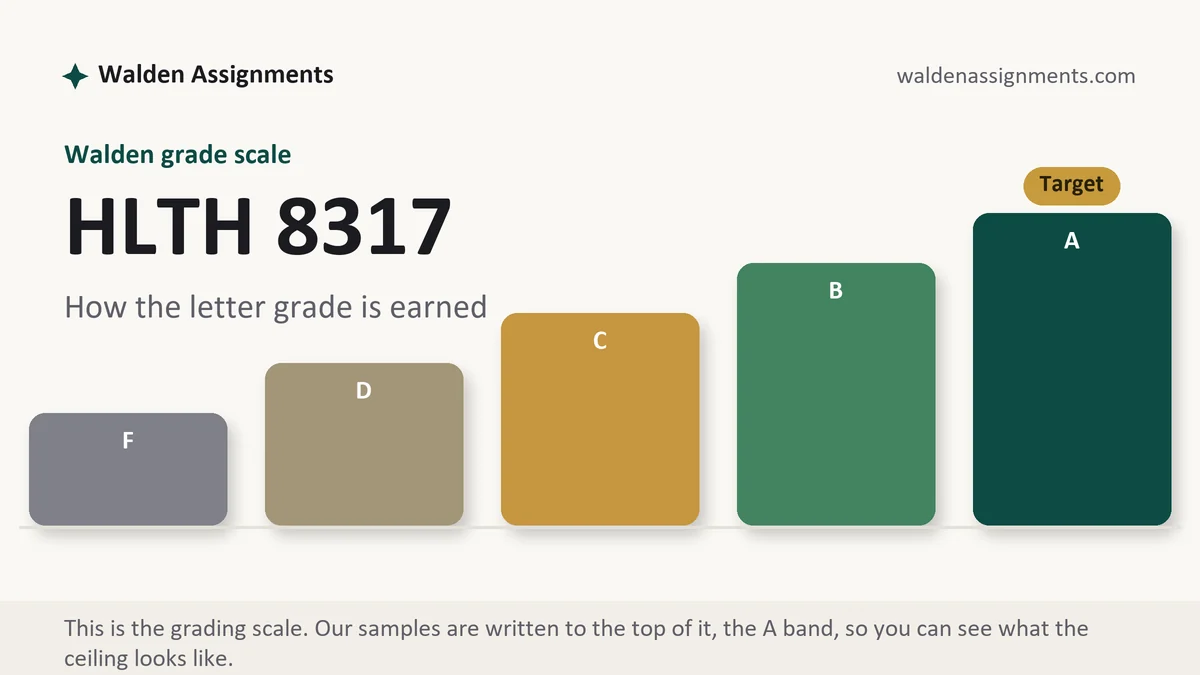
The HLTH 8317 drawers
HLTH 8317 Week 1 framing post example
Week 1 commonly asks where the money for a health department originates before anything else. On request, free, 24-48h.
HLTH 8317 Week 2 discussion post example
Week 2 threads generally argue whether the source of a dollar decides what it can buy. On request, free, 24-48h.
HLTH 8317 Week 3 funding map example
Week 3, as a rule, has writers map every stream that reaches one agency. On request, free, 24-48h.
HLTH 8317 Week 4 funding brief example
The week 4 paper, in many sections, argues what a restricted stream makes impossible to fund. On request, free, 24-48h.
HLTH 8317 Week 5 grant analysis example
Week 5 frequently examines a matching requirement and who actually supplies the local share. On request, free, 24-48h.
HLTH 8317 Week 6 peer critique example
Week 6 replies regularly test whether a classmate's fix survives the rules attached to the money. On request, free, 24-48h.
HLTH 8317 Week 7 sustainability brief example
Grant expiry, more often than not, is what week 7 makes the writer plan around. On request, free, 24-48h.
HLTH 8317 Week 8 allocation discussion example
Week 8 discussions, for the most part, weigh whether allocation across jurisdictions can be called fair. On request, free, 24-48h.
HLTH 8317 Week 9 revenue analysis example
Week 9 typically turns to reimbursement, and what billing for services does to an agency's mission. On request, free, 24-48h.
HLTH 8317 Week 10 counterargument brief example
Week 10 often demands the best argument for the funding structure you called inadequate. On request, free, 24-48h.
HLTH 8317 Week 11 synthesis paper example
Week 11 usually ends in one defended claim about what the current financing arrangement can support. On request, free, 24-48h.
Your classroom shows something else?
Walden University revises courses; week counts and deliverables shift between terms. Send what your classroom shows and the desk matches it exactly.
Using a HLTH 8317 sample the right way
Read a sample for its spine. Find the sentence that says what the funding origin makes impossible, then check which parts of the paper were built to support it and which are scenery. A useful test is to swap one stream for another and see whether the argument survives; if it does not, the paper was about the stream rather than about financing. Your own classroom rubric decides length, citation style and how many sources are expected, and a sample does not outrank it. You still write the submission yourself, and any figure you carry over needs a source you can point to.
How these samples are written
The discipline behind every paper here: the rubric is the outline, each row gets its section, discussions get the thread treatment with substantive replies, and the format layer ships exact. Send your classroom's rubric with a request and the sample matches it, revisions included.
HLTH 8317 questions, answered
Can I use my own agency's funding information in the paper?
Public figures are fine. Appropriations, published award notices, state program reports and legislative documents are all citable, and a paper built on them reads as scholarship. Internal numbers your employer has not published are a different matter: they belong to the organization, not to a class assignment, so keep them out and use the public record, which is usually richer than writers expect.
How much of the paper should be about actual dollars?
Less than most writers assume. The rubric is looking for an argument about structure, so the numbers exist to anchor claims rather than to fill pages. A short, sourced account of what a stream provides and what it restricts does more work than a long table, especially when the writer then shows a decision the agency cannot make because of where the money came from.
Is it acceptable to argue that a funding structure should stay as it is?
Yes. A defended position for the current arrangement can score as well as a call to change it, provided the paper meets the strongest case against. What the rubric refuses is the paper that surveys three financing options, notes advantages for each, and closes without saying which one the writer would defend and on what grounds.