Send the exact assignment or rubric from your classroom and a custom sample written to it lands in 24 to 48 hours, the first one free. DNRS 6501 is Walden’s Advanced Pathophysiology (DNP level) course. It centers on judging which of several plausible disease mechanisms the evidence actually supports, and what that judgment changes for advanced practice and the populations it serves. Searches like "dnrs 6501 week 4 assignment example", "DNRS6501 sample paper", and "DNRS 6501 week samples" land on this page.
What DNRS 6501 is really about
At the doctoral level, knowing a mechanism is the entry fee rather than the achievement. DNRS 6501 assumes you can already explain how an injured cell fails or how a failing circulation compensates, and it asks what sits underneath that explanation: which studies established it, how firmly, and whether a rival account fits the same findings. Much of the week-to-week work is adjudication. Two immune pathways both look plausible for one presentation; three renal mechanisms could each produce one laboratory pattern; a neurologic deficit could come from a lesion here or a process there. The graded move is choosing between them on evidence, including the evidence that argues against your choice, and saying plainly what would overturn the decision.
Consequence is the second expectation. A doctoral paper on pathophysiology is expected to end somewhere a practice could act: a screening question worth asking of a whole panel, a routine that rests on a weaker study than its reputation suggests, a pattern across several organ systems that should change which patients get looked at twice. That is why appraisal and critique weeks sit inside a mechanism course. Audience widens as well. Some assignments address colleagues already holding the article, some address readers outside the specialty who need one distinction made clearly, and some address a room through slides. Each audience changes what counts as enough explanation, and the rubric notices when the register is wrong.
What DNRS 6501’s assessments ask for
Threads recur across the term, and each tends to want a position argued with primary citations and a closing question that invites challenge backed by sources rather than agreement. Between them sit written pieces with distinct audiences. Early work may ask for a map whose links are defended in an annotation page, or a case settled between two immune explanations. Middle weeks commonly bring an appraisal of one primary article against the practice claim built on it, a short brief separating two lung mechanics for a non-specialist, and a differential ranking candidate mechanisms behind one laboratory pattern. Later weeks often add a journal club critique, a slide presentation with speaker notes, and a synthesis tying one mechanism across several systems to decisions in advanced practice. Judgment, not coverage, is what those criteria score.
Where students lose points in DNRS 6501
Nothing costs more here than a rival explanation left unstated. A case analysis or differential that argues for one mechanism without ever stating the alternative reads as advocacy, and graders at this level expect to watch the losing option being ruled out, including the findings that seemed to favor it. Next is the appraisal that repeats the abstract. Reporting what a study found is not the same as judging whether its methods justify the routine that cites it, and papers that skip sample, comparison and measurement leave that judgment unmade. Points drain away through review chapters standing in for primary studies, critiques that summarize before criticizing, slides crowded with paragraphs, briefs written for specialists when the prompt named a general reader, and closing syntheses that tour organ systems without ever naming a decision that should change.
The DNRS 6501 drawers
DNRS 6501 Week 1 discussion post example
An opening thread typically pins down the moment a hypoxic cell can no longer recover. On request, free, 24-48h.
DNRS 6501 Week 2 concept map example
Maps here often run from one gene variant to a recorded finding, each link defended or flagged. On request, free, 24-48h.
DNRS 6501 Week 3 case analysis example
Commonly, two credible immune explanations compete for one presentation, and the evidence has to pick one. On request, free, 24-48h.
DNRS 6501 Week 4 evidence appraisal example
Appraisal work usually asks how much of a popular practice claim one primary study can support. On request, free, 24-48h.
DNRS 6501 Week 5 discussion post example
Mid-term threads often argue which compensatory response in a failing circulation turns harmful first. On request, free, 24-48h.
DNRS 6501 Week 6 pathophysiology brief example
Expect, in many sections, obstructive and restrictive breathing explained side by side for a general reader. On request, free, 24-48h.
DNRS 6501 Week 7 differential analysis example
After kidney content, papers typically rank competing explanations for one set of abnormal values. On request, free, 24-48h.
DNRS 6501 Week 8 journal club critique example
Journal club weeks commonly critique a mechanism study for peers who know it already. On request, free, 24-48h.
DNRS 6501 Week 9 discussion post example
Neurologic threads tend to decide between two lesion accounts on a finding that is missing. On request, free, 24-48h.
DNRS 6501 Week 10 case presentation example
Slides with speaker notes often argue a multisystem case one mechanism cannot account for alone. On request, free, 24-48h.
DNRS 6501 Week 11 synthesis paper example
The final paper usually follows one mechanism through three systems toward decisions practice could change. On request, free, 24-48h.
Your classroom shows something else?
Walden University revises courses; week counts and deliverables shift between terms. Send what your classroom shows and the desk matches it exactly.
Using a DNRS 6501 sample the right way
Read a DNRS 6501 sample for its concessions. Locate the passage in which the paper admits what its chosen mechanism fails to explain, or where an appraisal disagrees with its own tool, and ask why that paragraph strengthens the argument rather than weakening it. That habit is the one doctoral rubrics reward and the one drafts most often leave out. Then check each citation against the claim beside it: is the source primary, and does it say what the sentence says? Once you see the pattern, set the sample down and choose your own article, pattern or presentation, because the appraisal has to be yours to be worth anything in practice.
How these samples are written
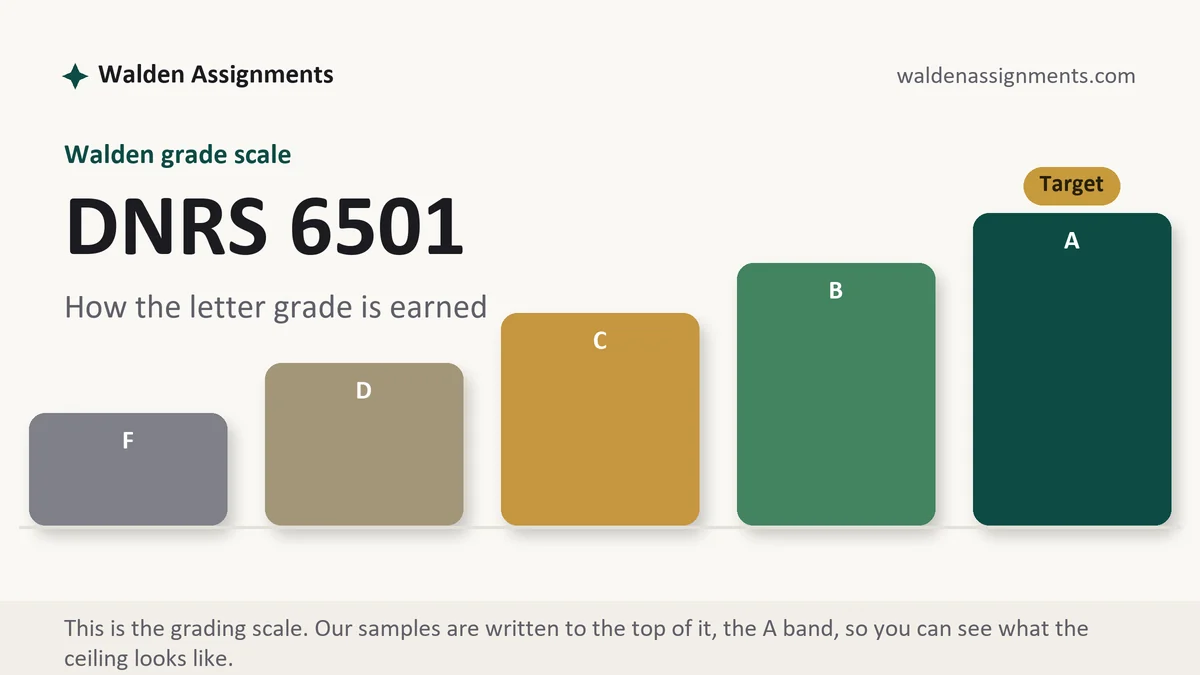
Every sample on this shelf is written the way the custom ones are: the rubric decoded row by row, a subject-matched writer drafting to the top band, formatting checked line by line. Walden revises classrooms, so a custom request is always written to the rubric in YOUR course, never from a stale template.
DNRS 6501 questions, answered
How does DNRS 6501 differ from a master's-level pathophysiology course?
The mechanisms overlap; the demand does not. Here an explanation is treated as a position that needs defending against a rival and a source base that needs weighing, and several weeks ask you to appraise or critique studies rather than to explain a case. Expect primary literature to outweigh textbooks, and expect every paper to end on what the argument changes for practice.
Which appraisal tool should a DNRS 6501 evidence appraisal use?
Whichever your classroom names, and if none is named, one matched to the study design in front of you. The tool matters less than how it is applied: criteria worked through against the actual methods, and a stated disagreement wherever the checklist misses something the design gets wrong. A completed checklist with no judgment attached reads as clerical work, and the rubric is looking for the judgment.
How much should a DNRS 6501 paper say about practice?
One or two specific consequences, argued, rather than a closing paragraph about awareness. A mechanism paper at this level earns its conclusion by naming a decision that would change: which patients are screened, which assumption in a routine protocol deserves a second look, which finding should prompt a different referral. Keep that conclusion inside what the evidence supports, and say so where the support is thin.