Send the exact assignment or rubric from your classroom and a custom sample written to it lands in 24 to 48 hours, the first one free. DDBA 8511 is Walden’s Seminar in Innovation Management course. It centers on the machinery an organization builds so new offerings arrive on a schedule rather than whenever someone talented gets bored. Some program versions carry this course as DBAX 8511; the same drawers apply. Searches like "ddba 8511 week 4 assignment example", "DDBA8511 sample paper", and "DDBA 8511 week samples" land on this page.
What DDBA 8511 is really about
Innovation management is the least romantic version of the subject, and that is the version this seminar grades. The question is not whether an organization values new ideas, since every organization says it does, but what it has actually built so that ideas get funded, staffed and killed on some defensible basis. Stage gates, dedicated budgets, protected time, a person whose job is to say no: these are the objects of study. A doctoral paper here treats them the way an engineer treats a pump, asking what goes in, what comes out and where the thing jams. Firms are examined here as systems that either produce novelty on purpose or do not, and the seminar is interested in why.
The reading is unusually quarrelsome, which is a gift to a writer. Scholars disagree about whether exploration and exploitation can share one structure, whether opening a firm to outside inventors raises or lowers the return on its own research, and whether anything called an inventive culture survives being measured. A paper that reports all sides politely and concludes that context matters reads as unfinished at this level. You are expected to take a side, say plainly what evidence would embarrass you, and hold the position through replies from people who read the same articles and drew the opposite conclusion. Credit follows the defended claim rather than the balanced summary that declines to make one.
What DDBA 8511’s assessments ask for
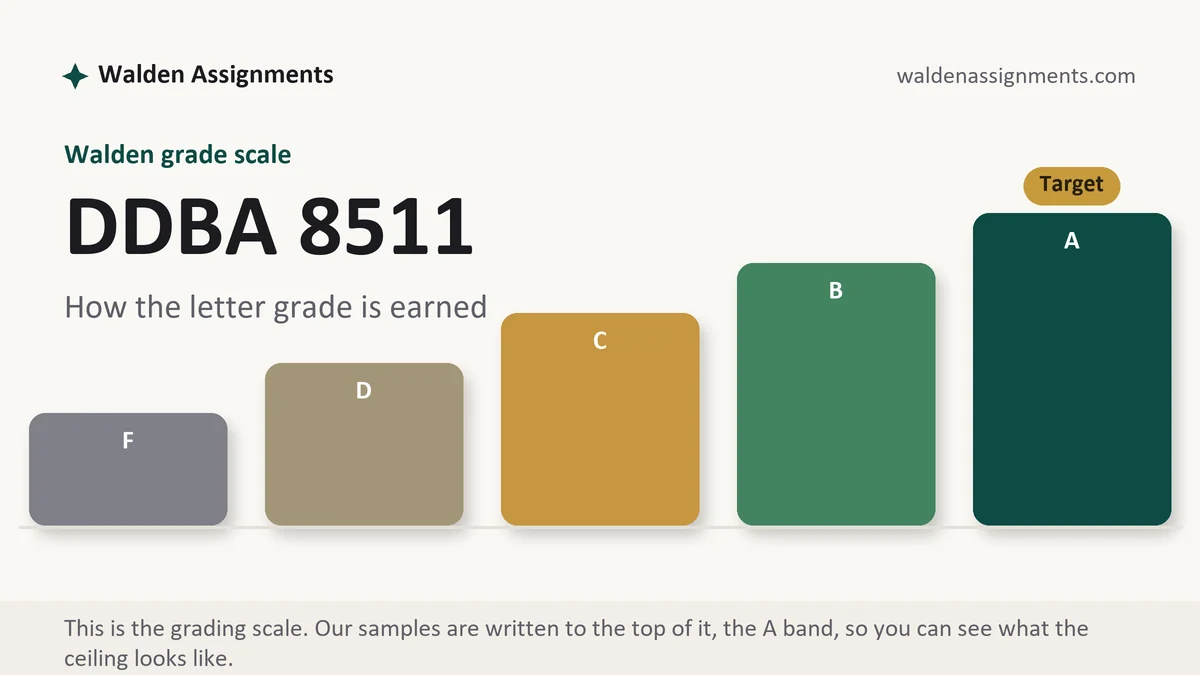
Weeks pair discussion posts with formal papers, and both are graded as argument. An initial post has to stake something a classmate could refuse, and the replies are where the grade moves: extend it, complicate it or reject it, with a reason and a source attached. The papers want a named organization and a named mechanism inside it, described closely enough that a reader could tell whether the thing exists. Markers look for the sequence, meaning who proposed, who authorized, which budget line paid and what shipped. They also want the counterfactual, which is what this firm would have done under its previous arrangement. Currency matters, since an arrangement described from an old case may have been dismantled since. Your classroom's rubric decides the format and the weighting.
Where students lose points in DDBA 8511
Points leave first for the closing recommendation with no verb attached to anybody, a call for greater inventiveness that names nobody who would do it and nothing anyone would stop doing to make room. Second is celebration: a famous firm praised for its outcomes while the arrangement that produced them goes undescribed. Third is the definition problem, where a paper counts patents in one paragraph, new services in the next, and reaches a finding that depends entirely on which one you meant. Fourth is leaning on one much-cited author whose critics sit in the same reading list and go unmentioned. In discussion, the reply that agrees warmly and adds a citation scores near the floor, since nothing in the thread had to change.
The DDBA 8511 drawers
DDBA 8511 Week 1 discussion post example
Week 1 typically asks what counts as an innovation before anyone argues about managing one. On request, free, 24-48h.
DDBA 8511 Week 2 case analysis example
Week 2, as a rule, wants the source of a new idea located inside a real firm. On request, free, 24-48h.
DDBA 8511 Week 3 position paper example
Week 3, for the most part, treats strategy as the choice of which novelty to fund. On request, free, 24-48h.
DDBA 8511 Week 4 portfolio analysis example
Week 4, more often than not, puts a mixed set of projects in front of you for weighting. On request, free, 24-48h.
DDBA 8511 Week 5 structure memo example
Week 5, in many sections, turns to structure and who is permitted to break a routine. On request, free, 24-48h.
DDBA 8511 Week 6 literature appraisal example
Week 6 usually asks whether an inventive culture can be managed or only described afterward. On request, free, 24-48h.
DDBA 8511 Week 7 partnership case example
Week 7 commonly opens the firm outward, toward partners who own part of the invention. On request, free, 24-48h.
DDBA 8511 Week 8 measurement critique example
Week 8, in most classrooms, wants a measure that could tell you the program had failed. On request, free, 24-48h.
DDBA 8511 Week 9 model analysis example
Week 9 generally moves from the invention itself to the model that carries it to buyers. On request, free, 24-48h.
DDBA 8511 Week 10 implementation brief example
Week 10 often lands on launch, where a working prototype meets a calendar and a cost. On request, free, 24-48h.
DDBA 8511 Week 11 synthesis paper example
Week 11 routinely closes by asking what your organization should stop doing to make room. On request, free, 24-48h.
Your classroom shows something else?
Walden University revises courses; week counts and deliverables shift between terms. Send what your classroom shows and the desk matches it exactly.
Using a DDBA 8511 sample the right way
The objection a finished paper here has to survive is that its mechanism is decoration, a committee that meets and changes nothing. Watch where the sample answers that: the paragraph tracing one funded decision through to something a customer could buy, with dates and a named sponsor attached. Weak papers answer it nowhere and trust the reader to be agreeable. The second objection, that the firm would have got there anyway, is answered in the paragraph setting the arrangement against whatever preceded it. Your prompt, your instructor and your rubric settle everything else. Write your own submission; a sample is here to be argued with.
How these samples are written
The discipline behind every paper here: the rubric is the outline, each row gets its section, discussions get the thread treatment with substantive replies, and the format layer ships exact. Send your classroom's rubric with a request and the sample matches it, revisions included.
DDBA 8511 questions, answered
Does DDBA 8511 want theory or company examples?
Both, and the papers fail when they carry only one. Theory without a firm attached becomes a reading summary; a firm without theory becomes a story anyone could tell. The workable shape is a claim about how novelty gets produced, borrowed from the literature, then tested against one organization whose arrangements a reader could go and check for themselves.
How current do the sources have to be?
Current enough that the arrangement you describe probably still exists. Foundational articles stay useful for the concepts they named, but a firm's structure from years ago may have been reorganized twice since, and a marker who knows that reads your paper as out of date. Pair the older theory with recent evidence about the organization itself.
Can I write about the company I work for?
Many people do, and it usually improves the paper, because you know what actually happens rather than what the annual report claims. Keep anything confidential out of what you submit, and note that your internal documents stay yours. Our samples are written to the structure of the prompt and rubric you send us, never from your employer's records.